
What This Paper Is About
B2B wholesale runs on trust. A manufacturer needs to know that a corporate buyer placing a bulk order has real money and real backing. A supplier responding to an Invitation-To-Bid needs to know the requestor is legitimate. A wholesaler needs proof before approving supplier applications or extending credit.
We built an automated email verification system to solve this problem. This paper explains how it works, why we built it, and what happens when verification fails.
Verification is pass or fail. No exceptions. No manual review.
Chapter 1: The Real Problem
1.1 The Cost of Fake Inquiries
An unverified account submits a Request For Quotation. Our sales team responds. They prepare pricing. They check inventory. They follow up. Then the buyer disappears.
That wasted time adds up. For suppliers on our platform, repeated fake inquiries mean fewer hours for legitimate customers.
1.2 The cancellation pattern we see repeatedly
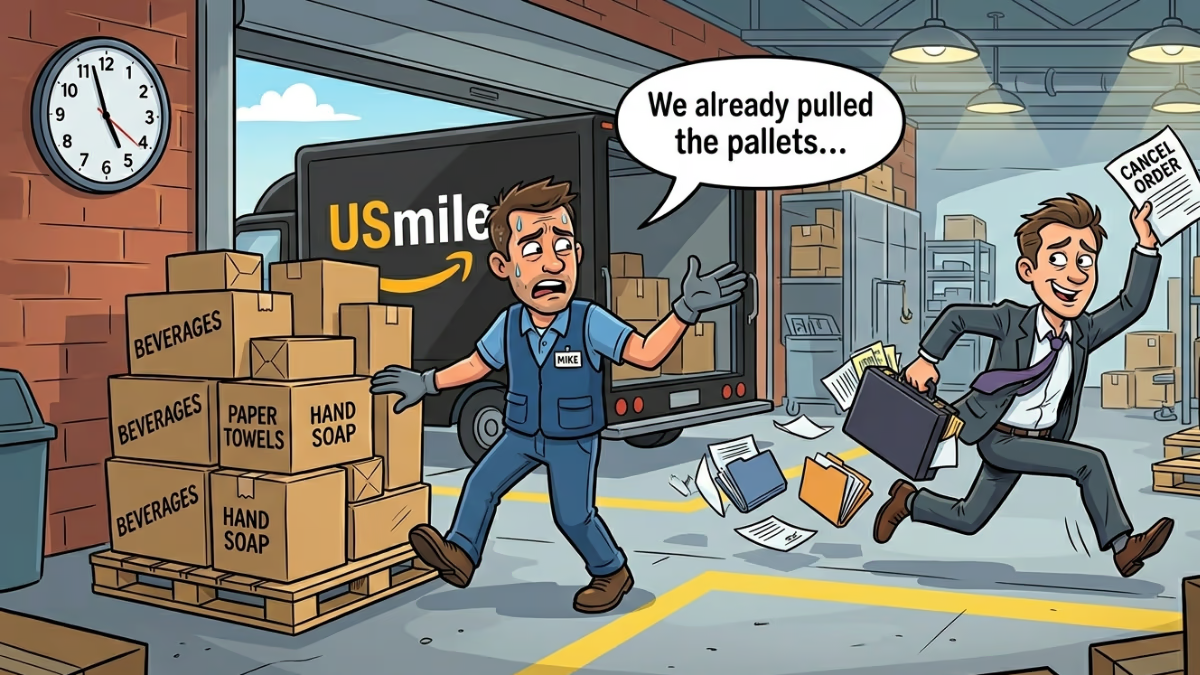
We have documented a clear pattern. A company submits a Purchase Order for bulk quantities. Items are reserved and prepared for distribution. Then the buyer cancels.
Who cancels? Usually a sole proprietorship or trading business. They act as middlemen. They secure goods before their own client approves the price or product specs. When their client backs out, they cancel on us.
Real examples from our operations:
| Product Category | Operational Bottleneck |
|---|---|
| Fast moving beverage SKUs | Bulk allocation issues tie up fast-moving inventory layers that other buyers need immediately. |
| Bulky paper products | High physical handling volume requires intensive outbound logistics preparation; subsequent cancellations double operational resource consumption via reverse workflows. |
| Hygiene essentials for healthcare buyers | Hospitals and clinics experience artificial shortages when procurement requests are locked in process by unverified accounts. |
| Our proprietary chemical line | Manufactured for Clickerwayne Zelle Solutions Inc and allocated to our dedicated distribution networks; late-stage cancellations disrupt production runs and storage area allocation. |
1.3 Why manual checks do not work
We tried traditional verification. It failed for three reasons.
- First, scanned documents are easy to fake. A PDF business permit from an unverified email address proves nothing about who placed the order.
- Second, public registry lookups confirm a company exists. They do not confirm that the person placing the order represents that company.
- Third, manual workflows take too long. Corporate buyers want instant RFQ responses. Manual verification drives legitimate customers away while doing nothing to stop fraudsters.
Automated email verification solves all three problems.
Chapter 2: How Email Domain Verification Works
2.1 What we check
We check three public, verifiable signals about the email domain. We do not read email content. We do not store messages.
You pass all three signals or you do not get access. No exceptions.
2.2 Signal One: Mail Exchange (MX) Records
A real business must operate mail servers that can receive messages. This is a basic internet standard.
What we check:
- Does the domain have published MX records?
- Do those MX records point to active mail servers?
- Can those mail servers accept incoming connections?
Technical standard: RFC 5321 from the Internet Engineering Task Force (IETF). Section 5.1 says mail delivery requires proper MX record configuration. Domains without MX records cannot receive email.
If you fail this check: Your domain has no working mail servers. You cannot receive email. We cannot do business with you.
2.3 Signal Two: Domain Age
Fraudsters use new domains because their setups are disposable. Legitimate businesses keep the same domain for years.
What the data shows:
| Source | Findings |
|---|---|
| AtData / Merchant Risk Council (MRC) 2025 | Email addresses created days before a transaction were 25 times more likely to be fraudulent. |
| Interisle Consulting Group 2025 | Malicious domain registrations rose 149% year over year. |
| APWG Phishing Report Q2 2025 | Gmail accounted for 70% of free webmail accounts used in Business Email Compromise scams. Average wire transfer request: $83,099. |
If you fail this check: Your domain is too new. We cannot verify your business history.
2.4 Signal Three: Business Email Detection
Consumer email services like Gmail, Yahoo, and Outlook provide no business verification. Anyone can create an account instantly. No business registration required. No accountability.
A company email address (procurement@companyname.com) tells us you represent a specific business. Your domain owner controls who gets an email address.
Business Information Industry Association (BIIA) Report March 2026: Impersonation scams rose 148% year over year. More than half involved criminals posing as legitimate businesses using consumer email addresses.
If you fail this check: You are using a consumer email provider. We cannot verify you represent a real business.
Chapter 3: Who Must Verify
Three groups must pass verification. No exceptions.
3.1 Corporate Buyers
Any company submitting a Request For Quotation must verify. Verified buyers get instant quotes. Unverified submissions are rejected.
Verification tells us:
- You have legitimate mail infrastructure
- Your domain has established history
- You represent a business, not a consumer account
3.2 Suppliers
Any supplier offering us products must verify. Verified suppliers move to onboarding. Unverified applications are rejected.
Verification tells us:
- You have operational mail infrastructure
- Your business has established domain history
- You are not using a consumer email address
3.3 Bidders
Any company responding to an Invitation-To-Bid must verify. Verified bidders get bid package access. Unverified requests are rejected.
Verification protects sensitive bid documents including specifications, logistics requirements, and pricing.
Chapter 4: The Verification Rules
4.1 For Corporate Buyers
| Check | What You Need | What Happens If You Fail |
|---|---|---|
| MX Records | Valid MX records that respond | RFQ rejected |
| Domain Age | Domain meets minimum registration age | RFQ rejected |
| Business Email | Company domain, not Gmail/Yahoo/Outlook | RFQ rejected |
4.2 For Suppliers
| Check | What You Need | What Happens If You Fail |
|---|---|---|
| MX Records | Valid MX records that respond | Accreditation rejected |
| Domain Age | Domain meets minimum registration age | Accreditation rejected |
| Business Email | Company domain, not Gmail/Yahoo/Outlook | Accreditation rejected |
4.3 For Bidders
| Check | What You Need | What Happens If You Fail |
|---|---|---|
| MX Records | Valid MX records that respond | Bid access denied |
| Domain Age | Domain meets minimum registration age | Bid access denied |
| Business Email | Company domain, not Gmail/Yahoo/Outlook | Bid access denied |
Chapter 5: The Data Behind This Decision
5.1 Business Email Compromise (BEC) Trends
APWG Q2 2025 data shows BEC attacks remain the highest impact payment fraud. Attackers impersonate corporate buyers to redirect payments or obtain goods.
- Average wire transfer request: $83,099
- 97% increase from Q1 2025
- Gmail accounts: 70% of free webmail used in BEC attacks
5.2 Procurement Fraud is Widespread
PwC Global Economic Crime Survey 2024:
- 55% of companies report procurement fraud as a widespread concern
- Nearly 20% do not use data analytics to identify procurement fraud
5.3 Domain Registration Abuse is Rising
Interisle Cybercrime Supply Chain Report 2025:
- Cybercrime incidents increased 60%
- Malicious domain registrations rose 149% year over year
- Short lived domains dominate fraudulent activity
5.4 Business Identity Theft is Growing
BIIA Report March 2026:
- Impersonation scams rose 148% year over year
- Majority involve criminals posing as legitimate businesses
- Fraudsters spoof business identities to get high value goods
5.5 Email Age Predicts Fraud Risk
AtData / MRC Report July 2025:
- Email addresses created days before transaction: 25 times more likely to be fraudulent
- Disposable email domains: fraud rates exceeding 70%
Chapter 6: Agentic AI Commerce is Coming
6.1 What is agentic AI commerce?
AI agents will buy and sell on behalf of companies without human intervention. Industry analysts project massive adoption.
Gartner predicts: By 2028, 90% of B2B buying will be AI agent intermediated. That is over $15 trillion of B2B spend moving through AI agent exchanges.
Forrester finds: 74% of B2B organizations are already adopting AI agents. Another 14% plan to adopt them.
These agents will:
- Authenticate using corporate email credentials
- Submit RFQs across multiple suppliers at once
- Compare pricing and terms algorithmically
- Execute purchase orders without human approval at each step
6.2 The verification challenge
For wholesale platforms, AI agents create a new problem. How do we distinguish between:
- A legitimate AI agent operating for a verified corporate buyer?
- A malicious bot scraping our pricing to undercut us?
- A fraudulent agent submitting fake RFQs to disrupt our operations?
Gartner notes: "Machine buyers can reduce procurement cycles from months to seconds." NEC, a Japanese IT firm, already deployed these agents in procurement. They reduced negotiation times to under one minute. Manual negotiation took between three and 48 hours.
6.3 Email verification works for AI agents too
Email domain verification solves the AI authentication problem. The AI agent carries the same verified corporate email credential as a human buyer. Our system does not need to know if you are human or agent. It only needs to know that your credential represents a legitimate business with proper mail infrastructure and domain history.
Gartner's roadmap for deploying machine buyers requires:
- Sender identity verification (MX records confirm this)
- Trust and transparency with partners (verified credentials provide audit trail)
- Context data availability (domain history provides operational context)
Email verification delivers all three requirements.
6.4 What happens to platforms without verification?
Analysts predict AI shopping agents will bypass traditional marketing channels entirely. When an AI agent purchases on behalf of a corporate buyer, it will skip sponsored product rankings, display advertising, and paid recommendation lists.
For wholesale platforms, this means: Unverified platforms risk being completely invisible to AI agents. The agent will route transactions to verified, trusted platforms that can authenticate the agent's credentials.
Forter, in collaboration with AWS, Shopify, and others, notes: "The same dynamics that create risk also create opportunity. If you build the foundations that agents reward - secure ecosystems, chat native storefronts, orchestrated payments, and modern infrastructure - you will put yourself on the path to growth."
6.5 Where we stand
Our verification system launches Q3 2026. The three signal framework (MX records, domain age, business email detection) creates the authentication infrastructure that AI agents require.
Platforms without automated verification will face:
- No way to authenticate AI originated RFQs
- Vulnerability to bot driven price scraping
- Manual review bottlenecks as transaction volume increases
- Invisibility to AI shopping agents
We built automated verification to eliminate these vulnerabilities before they emerge.
Chapter 7: Technical Standards We Follow
| Standard | What It Covers |
|---|---|
| RFC 5321 | MX record requirements for core mail infrastructure delivery paths. |
| RFC 7208 | Sender Policy Framework (SPF) parameters for automated identity validation overlays. |
| RFC 7480 | RDAP query implementation rules for parsing structured entity registration timestamps. |
Chapter 8: Rollout Schedule
8.1 Target launch: Q3 2026
We are developing the verification system now. Target rollout is Q3 2026.
8.2 Phased rollout
| Phase | Target Scope & Integration Parameters |
|---|---|
| Phase 1 (Q3 2026) | Inbound RFQ validation gateways and terminal supplier accreditation requests. |
| Phase 2 (Q4 2026) | Invitation-To-Bid (ITB) document access filters and structural scoring configurations. |
| Phase 3 (Q1 2027) | Omnichannel system alignment across remaining business-to-business processing directories. |
8.3 We will notify you
We will email affected participants before each phase. No surprises.
Chapter 9: The Bottom Line
Email domain verification gives us an automated, standards based way to validate corporate buyers, suppliers, and bidders before they access our RFQ system, submit supplier applications, or receive Invitation-To-Bid documents.
Three signals determine verification:
- MX record presence and responsiveness (RFC 5321 standard)
- Domain age (registration history)
- Business email detection (no consumer providers)
Verification is pass or fail. If you fail, you do not get access. No exceptions. No manual review.
Research from APWG, Interisle, PwC, AtData/MRC, and BIIA confirms that unverified email domains correlate strongly with fraud, cancelled orders, and business identity theft.
The agentic AI reality: Gartner projects 90% of B2B buying will be AI agent intermediated by 2028. Automated email verification is not optional anymore. It is the trust layer that enables AI-driven procurement at machine speed. Platforms without automated verification will be invisible to AI agents and vulnerable to bot driven fraud.
We launch Q3 2026. This system protects corporate buyers, suppliers, and bidders by ensuring everyone has legitimate, verifiable commercial infrastructure at the first point of contact. Today and in the AI-driven future.
References and Sources
| Source | Publication |
|---|---|
| IETF | RFC 5321 - Simple Mail Transfer Protocol |
| APWG | Phishing Activity Trends Report Q2 2025 |
| Interisle | Cybercrime Supply Chain Report 2025 |
| AtData / MRC | Four Key Email Indicators Driving Fraud in Digital Payments (July 2025) |
| BIIA | Building Resilience Against Business Identity Theft (March 2026) |
| PwC | Global Economic Crime Survey 2024 |
| Stanford University | Supplier Explorer Tool |
| Gartner | Deploy AI Agents in Procurement (March 2026) |
| Forrester | State Of Customer Obsession Survey, 2025 |
| Forter/AWS/Shopify | The Age of Agentic AI (September 2025) |