
Ask yourself a question.
When was the last time a wholesale delivery arrived exactly when promised, with everything you ordered, no missing items, no damaged boxes, no excuses?
Take a moment. Really think about it.
If you cannot remember, you are not alone. Most purchasing managers, restaurant owners, and hotel operators across Cavite, Laguna, Batangas, and Metro Manila have learned to expect problems. Late trucks. Incomplete orders. Quality that changes month to month. Payment fees that add five percent for no reason other than someone clicked a button.
But before going further, let us define what HORECA actually means in the Philippine context.
What is HORECA? A Philippines-Focused Definition
HORECA stands for Hotels, Restaurants, and Cafes or Catering. But in the Philippine wholesale industry, the term has grown to mean something broader.
HORECA in the Philippines refers to any business that serves food, drinks, or accommodation to customers outside their own home. This includes not just hotels, restaurants, and cafes, but also commissaries, industrial canteens, resort kitchens, hospital food services, corporate pantries, and food service operations inside economic zones.
What makes the Philippine HORECA market different from other countries is the geography. A hotel in BGC has different supply needs from a resort in Batangas. A restaurant inside FPIP serves thousands of factory workers daily, not tourists. A café in Nuvali caters to work-from-home professionals, not weekend strollers.
The common thread is not the size of the business or the menu prices. The common thread is the supply chain. Every HORECA operation needs cleaning supplies, paper products, pantry items, and maintenance tools delivered reliably, week after week. When that supply chain breaks, the business feels it immediately.
This case study focuses on wholesale supply for HORECA operations located in Cavite, Laguna, Batangas, and Metro Manila. Specifically the industrial parks, commercial zones, and business districts where these businesses operate.
What You Will Learn in This Case Study
- Why HORECA buyers in Cavite, Laguna, Batangas, and Metro Manila are switching suppliers
- How to eliminate hidden payment gateway fees that cost you thousands per year
- Which industrial parks and economic zones have reliable wholesale delivery
- The specific cleaning and janitorial products you should consolidate under one supplier
- How to test a wholesaler before committing to a long term relationship
- Original research based on real RFQ data and documented buyer behavior
Reading time: 10 minutes
Table of Contents
- 1. The Real Cost of Sticking with a Bad Supplier
- 2. CEO Interview: Learning from Unfulfilled RFQs
- 3. Industrial Parks and Economic Zones: FPIP, LISP III, LTI, and More
- 4. What Makes a Reliable HORECA Supplier in Cavite Laguna Batangas Metro Manila
- 5. The Hidden Fee That Adds 5 Percent to Every Order
- 6. Product Categories You Can Consolidate Today
- 7. A Simple 5 Step Framework for Testing a New Wholesaler
- 8. Frequently Asked Questions About Wholesale Delivery to Industrial Parks
- 9. References and Sources
- Conclusion: What HORECA Buyers Should Do Now
- Ready to Test? Request a Quotation
Part One: The Real Cost of Sticking with a Bad Supplier

Here is another question.
How much money did you lose last year because of supplier problems? Not just the obvious costs like rush shipping or spoilage. The hidden costs too. Your time. Your staff's time. The stress of explaining to your boss or your guests why something is out of stock.
Add it up. The real number might surprise you.
The good news is that better options exist. A growing number of HORECA suppliers in Cavite, Laguna, Batangas, and Metro Manila are moving away from the old way of doing business. They deliver on time. They charge no hidden fees. They treat your business like it matters.
Consider what HORECA buyers actually deal with week to week.
A restaurant owner in Alabang needs trash bags that do not split open during the dinner rush. A hotel purchasing manager in BGC needs interfolded paper towels that arrive before the housekeeping team runs out. A commissary operator inside FPIP Batangas needs consistent pricing on bleach, multi-purpose cleaner, and laundry powder across dozens of SKUs.
These are not complicated requests. They are basic operational needs. But traditional wholesalers fail at them constantly. Not because they are bad people. Because their systems were built for a different era.
The wholesale and retail trade sector is the largest source of employment in the Philippines, engaging over 10.2 million workers and contributing P4.9 trillion to the economy. In 2025 alone, the Philippine Economic Zone Authority or PEZA surpassed its investment target, approving PHP260.89 billion in projects, up 21.91 percent from the previous year. Manufacturing investments in the first half of 2025 soared to P26.63 billion, up 165 percent compared to the same period in 2024. The accommodation and food service activities sector contributed PHP144.1 billion to the Philippine GDP in the third quarter of 2025.
These numbers tell a clear story. The HORECA and wholesale sectors are growing. But growth brings pressure on supply chains. The businesses that succeed will be those with reliable wholesale partners.
The wholesalers winning today are the ones who have rebuilt their operations around customer-centric principles. They track delivery windows like courier companies do. They offer payment options that do not add sneaky percentage fees. They maintain consistent quality across every batch, every order, every single time.
"The wholesalers winning today are not the biggest. They are the most reliable."
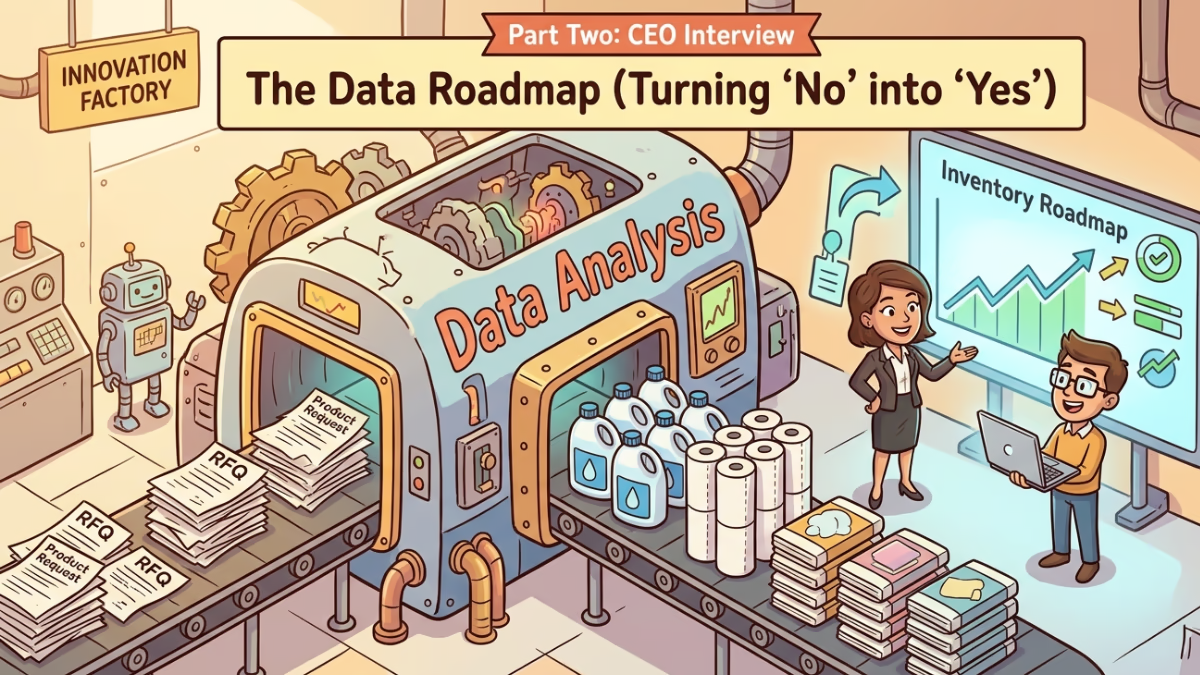
Part Two: CEO Interview. Learning from Unfulfilled RFQs

Every business makes mistakes in the beginning. The difference between companies that improve and companies that stay stuck is whether they study those mistakes or ignore them.
For Wholesale Dito Store, the mistake was saying no too often.
When the company started receiving inquiries from HORECA buyers across the Philippines, the response was often the same. "Sorry, we do not carry that product." The team had built a solid system for cleaning supplies through their Zachem brand. They had built a proprietary checkout system called N∅FEE Direct Settlement that eliminated payment gateway fees. But the broader product categories that HORECA buyers needed? Paper towels in bulk. Pantry items. Maintenance hardware. Those were not in the inventory list.
Instead of getting frustrated or giving up, the founders decided to study the problem.
Here is what Zelle, Co-Founder and CEO of Clickerwayne Zelle Solutions Inc., had to say about that period.
"When we were starting, we received a lot of inquiries from industries like HORECA. Most of the products they were looking for were not in our inventory list. Our first instinct was always to find a manufacturer or supplier that we could tie up with for those items. But the most important realization came later. We did not know how to handle or address these inquiries properly. We had no standard protocol, no process. Most of the time, we were not able to close the transaction.
So we stopped focusing on how to close a sale. Instead, we assessed our own behavior and process for handling these clients. We did an introspection to better our ways of serving them. We built a process. We conducted an analysis of how we handled inquiries, our workflow, our response patterns, and our internal decision making. That analysis became the foundation for everything we built after."
"We stopped focusing on how to close a sale. Instead, we assessed our own behavior and process. That analysis became the foundation for everything we built after."
— Zelle, Co-Founder and CEO, Clickerwayne Zelle Solutions Inc.
Clickerwayne, Technical Co-Founder and the architect behind the company's digital infrastructure and Progressive Web App or PWA, added this perspective.
"From a technical standpoint, the problem was not just about missing products. It was about missing data. We had no system for tracking what buyers were asking for, no way to spot patterns across hundreds of inquiries, no feedback loop between sales and inventory planning. So we built one. We documented every RFQ we received, every product request we could not fulfill, every question buyers asked that we could not answer. That data became our roadmap. Instead of guessing what to stock next, we let the buyers tell us."
"We documented every RFQ we received, every product request we could not fulfill. That data became our roadmap. We let the buyers tell us what to stock next."
— Clickerwayne, Technical Co-Founder
This approach of documenting unfulfilled demand is rare in wholesale. Most distributors simply move on to the next sale. But for Wholesale Dito Store, the RFQs they had to decline became their most valuable research asset.
The company is a member of the Clickerwayne Group of Companies and operates under Clickerwayne Zelle Solutions Inc., which was registered with the Securities and Exchange Commission on June 27, 2023. The business originally started during the COVID-19 pandemic, selling pre-owned items online before pivoting to wholesale. Today, the company serves B2B clients across four provinces with a focus on cleaning and janitorial supplies, including their flagship private label brand Zachem, which launched in May 2025.
The lesson for other wholesalers is simple. Your declined RFQs are not failures. They are free market research. If you document what buyers ask for and cannot get from you, you have a direct line to what they actually need.
Part Three: Industrial Parks and Economic Zones. FPIP, LISP III, LTI, and More.

Based on a real delivery story. In late 2023, a Japanese company inside FPIP (First Philippine Industrial Park) needed Jumbo Roll Tissue (JRT). Clickerwayne, Technical Co-Founder, used this as his personal logistics laboratory. For nearly two years, every purchase order became a test: distance from Binan to FPIP, needed safe speed calculations, SLEX traffic flow, unexpected circumstances, payload weight, gate clearance time. He would provide an ETA and most times he arrived 5 to 15 minutes early on every delivery. This illustration reflects that experience.
If your business is located inside an industrial park or economic zone, you already know the challenge.
Many wholesalers promise delivery to "Laguna" or "Batangas" but cannot get past the security gate at First Philippine Industrial Park or FPIP. They do not have the permits, the documentation, or the delivery systems to serve restricted zones.
But here is the reality. Some of the biggest HORECA operations in the country are inside these industrial parks. Commissaries. Industrial canteens. Food manufacturing facilities. Corporate cafeterias. These buyers need reliable wholesale delivery just as much as any hotel or restaurant.
In the first two months of 2024 alone, PEZA approved over P12 billion in investments, with projects located in industrial parks including FPIP II, LISP III, and Laguna Technopark. For 2025, PEZA surpassed its investment target, and the agency aims for PHP300 billion in approvals for 2026. The expansion of economic zones continues, with 10 new and expanded ecozones approved in 2025 and 14 more in the pipeline.
The industrial parks and economic zones that serious wholesalers should be able to serve include:
Santo Tomas Batangas
- First Philippine Industrial Park or FPIP
- Light Industry and Science Park III or LISP III
Binan Laguna
- Laguna Technopark or LTI
- Laguna International Industrial Park or LIIP
Carmona Cavite
- First Global Technopark along Governor's Drive in Barangay Ulong Tubig
- Cavite Light Industrial Park or CLIP
- Golden Mile Business Park in Barangay Maduya
- Southwoods Industrial Park in Barangay Mabuhay
- Mountview Industrial Complex Phase II
Metro Manila
- IT parks and centers in Makati, BGC Taguig, and Quezon City
- Food Terminal Incorporated Special Economic Zone in Taguig
- Macroasia Ecozone in Pasay
- Manila Harbour Center in Tondo Manila
- Amkor Technology Special Economic Zone in Muntinlupa
When evaluating a wholesale partner, ask them one direct question.
Do you deliver to my specific industrial park? Not "Metro Manila." Not "Laguna area." My actual park, my actual gate, my actual loading bay.
A supplier who hesitates or gives vague answers is telling you everything you need to know.
Part Four: What Makes a Reliable HORECA Supplier in Cavite Laguna Batangas Metro Manila
The old definition of a good wholesaler was simple. The one with the widest product selection at the lowest prices won. Service was an afterthought. Technology was something other industries used.
That definition no longer fits.
Today, a reliable HORECA supplier in Cavite Laguna Batangas Metro Manila must deliver on three fronts at the same time.
Product quality that stays consistent. Not just the first order. Every order. Batch after batch.
Operational reliability that you can set a watch to. Delivery windows that actually mean something. Communication when something changes.
Payment flexibility that does not punish you with hidden fees. No surprise percentage charges at checkout. No gateway taxes.
The Philippine government, through the Department of Trade and Industry, launched a blueprint for the wholesale and retail trade sector in June 2025. The blueprint is built on six strategic pillars: consumer centricity, competitiveness and coopetition, collaboration and public-private partnerships, digital transformation, human capital development, and supply chain resilience and integration.
This government recognition confirms what buyers already know. The wholesale sector is changing. Digital transformation is not optional. Supply chain resilience is not a buzzword. These are requirements for survival.
The hotel industry, in particular, is expanding despite economic challenges. Philippine hotel owners and investors continue to build more properties, including in the luxury segment. Filinvest Hospitality plans to add 2,000 more keys over the next five years. Ayala Land Hospitality aims to double its room inventory to 8,000 by 2030. Each new hotel needs a supply chain. Each new restaurant needs reliable wholesale delivery. The demand is there.
Here is a question for you.
How many different suppliers did you order from last month? Be honest. Count them.
Now ask yourself. How many of those suppliers could you eliminate if one partner covered eighty percent of your needs?
"What could you do with an extra 400,000 pesos this year? New kitchen equipment? A bonus for your best staff? Lower menu prices?"
Traditional Wholesaler vs. Tech-Driven Customer-Centric Wholesaler
| Feature | Traditional Wholesaler | Tech-Driven Customer-Centric Wholesaler |
|---|---|---|
| Delivery windows | Vague estimates, often missed | Trackable windows, real-time updates |
| Payment fees | 3-5% gateway fees passed to buyer | Direct settlement, zero MDR fees |
| Quality consistency | Varies by batch, no tracking | Lot tracking, consistent standards |
| Inventory visibility | Ask and wait for answer | Real-time availability |
| RFQ process | Multiple follow-ups, slow response | Transparent, fast, one-click option |
| Industrial park delivery | Complicated gate access, often fails | Standard procedure, documented permits |
| Customer feedback loop | No system for tracking requests | Every RFQ documented and analyzed |
Part Five: The Hidden Fee That Adds 5 Percent to Every Order

Here is a number that most HORECA buyers have never calculated.
Add up every payment gateway fee, transaction charge, and convenience fee from the last twelve months. Look at the total.
For a mid-sized hotel or restaurant group spending 200,000 to 500,000 pesos per month on supplies, those fees can easily reach 15,000 to 35,000 pesos per month.
That is 180,000 to 420,000 pesos per year. For the privilege of paying.
Stop and think about that.
What could you do with an extra 400,000 pesos this year? New kitchen equipment? A bonus for your best staff? Lower menu prices to beat competitors?
The worst part is that these fees add zero value. The payment gateway does not check inventory. Does not pack boxes. Does not drive a truck. It simply processes a transaction and takes a percentage. And most wholesalers simply pass these costs through to the buyer without a second thought.
Some wholesalers have fixed this problem. By building proprietary checkout systems that bypass third-party payment gateways entirely, they eliminate the MDR or merchant discount rate fees that have become an accepted cost of doing business.
For buyers, the math is simple. A wholesaler who offers direct settlement with no percentage fee is offering an immediate discount compared to one who adds three to five percent at checkout. Over a year of regular ordering, that difference adds up to real money.
Part Six: Product Categories You Can Consolidate Today
Here are the specific product categories that informed HORECA buyers are consolidating under fewer suppliers.
Floor care and maintenance
Mops, mop heads, and mop buckets that work with standard commercial wringers. Trash bins in multiple sizes for front-of-house and back-of-house use. Garbage bags rated for wet waste. The kind that do not leak across the kitchen floor halfway through a shift.
Paper and disposables
Interfolded paper towels that dispense properly without jamming. Bathroom tissue in commercial rolls that fit standard hotel and restaurant dispensers. These items get ordered every single week. Quality variation is not an option.
A note on paper towels. The market is full of cheap options that fall apart when wet. There are also overpriced imports that cost too much for daily use. The sweet spot is something like Femme paper towel or unbranded interfolded paper towel that delivers strength without the premium price tag. Japan quality interfolded paper towels and kitchen towel are also available.
Air care and sanitation
Air fresheners for guest bathrooms and dining areas. Disinfectants that actually meet commercial standards, not just consumer-grade sprays. For hotels in particular, the smell of the lobby and the cleanliness of the restrooms directly affect guest reviews.
Trusted commercial brands and professional grade solutions
Many HORECA buyers have specific brand preferences based on years of experience. Zonrox bleach for laundry and surface sanitation. Ajax multi-purpose cleaner for kitchen grease and bathroom soap scum. Surf powder soap for high-volume linen and uniform washing.
Beyond these, there is a growing category of professional-grade cleaning solutions that outperform consumer brands. Zachem Professional-Grade Cleaning Solutions is one example. The line includes Zachem Dishwashing Liquid for commercial kitchens that need grease-cutting power and Zachem Liquid Hand Soap for hotel restrooms and restaurant hand sinks. Zachem is manufactured in Taguig City and launched in May 2025 as the flagship private label brand of Clickerwayne Zelle Solutions Inc.
The opportunity for buyers is consolidation. Instead of buying mops from one supplier, paper towels from another, and cleaning chemicals from a third, a growing number of HORECA operations are finding single suppliers who cover most of their needs. The time savings alone justify the switch.
Part Seven: A Simple 5 Step Framework for Testing a New Wholesaler
For HORECA buyers who are tired of cycling through unreliable suppliers, here is a framework for testing a potential wholesale partner.
Step One: Test delivery reliability before you need it.
Place a small test order. Not the full monthly purchase. Just a few cases of something you regularly use. Track the delivery against the promised window. If the test order arrives late or incomplete, the full order will too. Move on.
Step Two: Calculate the all-in price, not the quoted price.
Ask for the final total including all fees, surcharges, and payment processing costs. Compare that to your current supplier. The lowest quoted price often becomes the highest final price once gateway fees and hidden charges are added.
Step Three: Check availability of your must-have products.
If your kitchen staff refuses to use anything except Zonrox bleach or Surf laundry powder, confirm that the wholesaler actually stocks those specific SKUs. Not substitutes. Not comparable alternatives. The exact products your team trusts.
Step Four: Ask about delivery to your specific industrial park or location.
Do not accept general promises about serving Metro Manila or Southern Luzon. Ask specifically about delivery to your address. Whether that is a restaurant in Pacita, a hotel in Ortigas Center, or a commissary inside FPIP Batangas. If the supplier hesitates or gives vague answers, keep looking.
Step Five: Test the RFQ process itself.
The request for quotation process reveals a lot about a wholesaler's capabilities. A smooth, transparent RFQ process. Where you can specify exactly what you need and receive a clear, complete quote without endless follow-ups. This indicates a supplier who takes procurement seriously.
A painful RFQ process predicts painful ongoing orders.
Part Eight: Frequently Asked Questions About Wholesale Delivery to Industrial Parks
Q: What is HORECA?
A: HORECA stands for Hotels, Restaurants, and Cafes or Catering. In the Philippines, it refers to any business that serves food, drinks, or accommodation to customers outside their own home. This includes commissaries, industrial canteens, resort kitchens, hospital food services, and corporate pantries.
Q: Do you deliver to First Philippine Industrial Park or FPIP in Santo Tomas Batangas?
A: Yes. Delivery to FPIP and Light Industry and Science Park III or LISP III is available. These economic zones have seen significant investment growth, with PEZA approving multiple projects in these locations. Specify your building and gate number when submitting an RFQ.
Q: Do you deliver to Laguna Technopark or LTI in Binan Laguna?
A: Yes. Delivery to Laguna Technopark and Laguna International Industrial Park or LIIP is available.
Q: Do you deliver to industrial parks in Carmona Cavite?
A: Yes. Delivery to First Global Technopark on Governor's Drive in Barangay Ulong Tubig, Cavite Light Industrial Park or CLIP, Golden Mile Business Park in Barangay Maduya, Southwoods Industrial Park in Barangay Mabuhay, and Mountview Industrial Complex Phase II is available.
Q: Do you deliver to economic zones in Metro Manila?
A: Yes. Delivery to IT parks in Makati, BGC Taguig, and Quezon City is available. Also delivery to Food Terminal Incorporated Special Economic Zone in Taguig, Macroasia Ecozone in Pasay, Manila Harbour Center in Tondo Manila, and Amkor Technology Special Economic Zone in Muntinlupa.
Q: What documentation do you provide for gate entry?
A: Standard delivery documentation includes company ID, delivery invoice, and gate pass forms. Specific requirements for each industrial park can be accommodated. Include your park's requirements when submitting an RFQ.
Q: Do you charge extra for delivery to industrial parks?
A: No. Delivery pricing is based on location and order size, not on whether the address is inside an industrial park. The same rates apply.
Q: How do I eliminate payment gateway fees?
A: Look for wholesalers who offer direct settlement systems that bypass third-party payment gateways. Some wholesalers have proprietary checkout systems with zero MDR or merchant discount rate fees.
Q: What cleaning products do you recommend for commercial kitchens?
A: Professional-grade solutions like Zachem Dishwashing Liquid for grease cutting and Zachem Liquid Hand Soap for hand hygiene. Also trusted retail brands like Zonrox bleach and Ajax multi-purpose cleaner.
Part Nine: References and Sources
This case study was researched and written using the following authoritative sources. All links are live and verified as of May 2026.
- Philippine Statistics Authority. GDP: Accommodation & Food Service Activities, Quarterly Data 2000-2025. CEIC Data.
- Department of Trade and Industry, Philippine Retailers Association, Supply Chain Management Association of the Philippines. Section G: Job Blueprint for Wholesale and Retail Trade (2025). PortCalls Asia.
- Philippine News Agency. PEZA surpasses 2025 target, eyes P300-B for 2026 (December 24, 2025).
- BusinessMirror. Manufacturing investments surge 165% to P26.6B in H1 2025 (July 14, 2025).
- GMA Network. PEZA approved P12B investments in Jan.-Feb. 2024 (February 20, 2024).
- TTG Asia. Philippine hotel owners optimistic despite dip in foreign arrivals (July 31, 2025).
- Baidu Baike. Restaurant Definition and Classification.
- Wholesale Dito Store. Who We Are: Company Background and History.
- Wholesale Dito Store. Zachem Professional-Grade Cleaning Solutions.
- Clickerwayne Digital Infrastructure
Conclusion: What HORECA Buyers Should Do Now
If you are a hotel general manager, restaurant owner, purchasing manager, café operator, commissary manager, or PhilGEPS bidder, your next step depends on your current situation.
If you have a supplier who delivers on time, charges no hidden fees, maintains consistent quality, and covers your specific location in Cavite, Laguna, Batangas, or Metro Manila, stay with them. That combination is rare. Do not take it for granted.
But if you are still dealing with late deliveries, surprise fees, quality variations, or procurement processes that waste your time, consider looking elsewhere. The market has better options now than it did five years ago. The government recognizes the need for digital transformation in the wholesale sector. Hotel and manufacturing investments are surging. The demand for reliable HORECA supply has never been higher.
"Your declined RFQs are not failures. They are free market research."
Wholesale Dito Store specializes in cleaning and janitorial supplies. Including dishwashing liquid, liquid hand soap, trash bags, interfolded paper towels, bathroom tissue, and trusted brands like Zonrox, Ajax and more. They carry Zachem Professional-Grade Cleaning Solutions, Femme paper towel, unbranded interfolded paper towel, Zachem Dishwashing Liquid, Zachem Liquid Hand Soap, and coming soon Japan-Quality Zachem interfolded paper towels and kitchen towels (from a Japanese manufacturer in Vietnam). Their N∅FEE Direct Settlement system eliminates payment gateway fees entirely.
But do not take any supplier's word for it. Test them. Send a request for quotation. See how they respond. Check their delivery for yourself.
That is the only way to know who actually belongs on your shortlist of trusted wholesale partners.
Ready to test a different kind of top wholesale experience?
Get your bulk price quotes instantly. Our On-Demand RFQ system is available 24/7.
Get Instant Quote