In Brief:
- Payment methods and payment terms are two different things. Most articles on this topic conflate them.
- Payment methods are how money moves. Payment terms are when money moves and under what conditions.
- This article covers both from the buyer's side. It is written for MSMEs and corporate procurement teams.
- Published MDR rates from Philippine payment providers range from 1.0 percent for QR Ph to 3.5 percent for cards. The arithmetic is in this article.
Rate and Regulatory Notice
Payment rates change. The MDR rates and transfer fees cited in this article are the published rates at the time of writing. GCash, Maya, and other providers may revise these rates at any time. Before relying on any figure in this article for a financial decision, confirm the current rate with the provider.
Regulatory rules change. The BIR invoicing requirements cited in this article reflect Revenue Regulations No. 7-2024 and related issuances as of the date of this article. The BIR may amend invoicing thresholds, required fields, or documentation rules. Confirm the current rules with the BIR or a tax advisor before relying on them for compliance purposes.
Direct Answer
Payment methods in the Philippines fall into four categories: digital wallets, bank transfers, cash, and cards. Payment terms in the Philippines fall into three categories: prepayment, due-on-delivery, and credit terms. For MSMEs and corporate buyers, the terms matter more than the methods. The method determines how the money moves. The terms determine how long the money stays in the business. This article covers both. It uses published rates from BSP-regulated payment providers. It does not assume a single market average.
Who This Is For
Philippine MSMEs sourcing wholesale for resale. You are evaluating a supplier's payment terms. You want to know what is standard, what is negotiable, and what the compliance requirements are.
Procurement officers at Philippine companies. You are evaluating a supplier's payment methods and terms. You need to know how the BSP regulates the payment rails and what the BIR requires for input VAT.
Finance teams evaluating supplier settlement. You are comparing the cost of a payment gateway against a direct bank transfer. You need the arithmetic and the source.
Part 1: Payment Methods
The BSP Framework
The Bangko Sentral ng Pilipinas operates the country's core payment infrastructure under the National Payment Systems Act (RA 11127). The BSP:
- Operates PhilPaSSplus, the Peso Real Time Gross Settlement system.
- Oversees the payment and settlement systems.
- Sets the regulatory framework for retail payments through the National Retail Payment System (NRPS).
The NRPS is built on three principles: interoperability, inclusivity, and "coopetition." The framework states that service fees for electronic payments are expected to be lower than fees collected from manual or over-the-counter transactions.
InstaPay
InstaPay is the real-time retail payment rail.
| Fact | Source |
|---|---|
| Maximum transaction size | ₱50,000 per transaction |
| Settlement speed | Real-time or near real-time |
| Availability | 24/7 |
| Primary use | Retail purchases, urgent payments |
The BSP launched InstaPay for Business (IFB) on July 29, 2026, which supports up to ₱500,000 per transaction for business-to-business payments.
PESONet
PESONet is the batch electronic fund transfer rail. It is the electronic alternative to the paper-based check system.
| Fact | Source |
|---|---|
| Maximum transaction size | No limit |
| Settlement speed | Batch. Same banking day if sent before cutoff |
| Availability | Banking days only |
| Primary use | Large-value transfers, supplier payments, payroll |
The Published Rates for Transfers
GCash and Maya reduced their InstaPay bank transfer fees to ₱10 effective July 2026, in compliance with BSP Circular No. 1238. PESONet transfers through Maya remain free.
Digital Wallets
The BSP regulates e-money issuers. The major wallets are GCash, Maya, GrabPay, and ShopeePay.
For B2B payments, digital wallets have a limitation. The sending account must be in the buyer's registered business name. A GCash account registered to an individual cannot fund a corporate order under most suppliers' reconciliation rules.
Cards
Credit and debit cards have low penetration in the Philippines. The World Bank estimates that only 3 percent of the population owns credit cards.
For B2B wholesale, cards are rare. The transaction sizes exceed typical card limits, and the MDR cost is prohibitive for large orders.
Cash on Delivery
Cash on Delivery remains a significant share of consumer e-commerce. It is estimated at around 42 percent by payment preference.
For B2B wholesale, COD is different. The buyer is a business. The cash changes hands at the warehouse or the delivery point. The invoice and Delivery Receipt are issued on the spot.
Part 2: Payment Terms
What Payment Terms Are
Payment terms are the conditions under which a buyer agrees to pay a supplier. They define the time the buyer has to pay, any discounts for early payment, penalties for late payment, and the accepted payment methods.
Standard formats:
- Advance payment. Payment is made before shipment.
- Payment on delivery. Payment is made when goods arrive.
- Net 30. Payment is due 30 days after the invoice date.
- 2/10 Net 30. A 2 percent discount is available if paid within 10 days. Otherwise, full payment is due in 30 days.
The Standard Terms in Philippine B2B
| Term | Meaning |
|---|---|
| Cash Before Delivery | Payment before shipment |
| Cash on Delivery | Payment on delivery |
| Net 7 | Payment due 7 days from delivery |
| Net 15 | Payment due 15 days from delivery |
| Net 30 | Payment due 30 days from delivery |
| Net 60 / Net 90 | Extended supplier terms |
The general pattern observed in Philippine distribution: shorter terms for new accounts, longer terms for established accounts with proven payment history.
The Post-Dated Check
In some Philippine B2B wholesale arrangements, credit terms are secured by a Post-Dated Check (PDC). The PDC is dated to the due date and deposited on that date.
A dishonored PDC may carry penalties under the supplier's terms. It also creates potential criminal liability under Batas Pambansa Bilang 22 (BP 22), the Bouncing Checks Law.
Not every Philippine supplier requires a PDC. The practice varies by supplier, category, and account history.
The Name-Match Rule
A name-match rule is a supplier-level fraud-prevention policy. Where it applies, the name on the sending account must match the name on the order. The rule prevents third-party payments, personal accounts funding corporate orders, and payments from one entity being applied to another entity's order. Not every Philippine supplier enforces it. Buyers should confirm the policy with each supplier before sending payment.
Part 3: The Arithmetic
The Published MDR Rates
Payment gateways charge a Merchant Discount Rate. The rate is a percentage of the transaction. The rate varies by payment method and by provider. The published rates from Philippine payment providers at the time of writing:
| Payment Method | MDR | Source |
|---|---|---|
| QR Ph (e-wallets / banking apps) | 1.0% | GCash |
| Credit / Debit Cards (Mastercard/Visa) | 3.2% | GCash |
| Credit / Debit Cards (Mastercard/Visa) | 3.5% + ₱10 per transaction | Maya |
GCash provides an example on its Help Center: on a PHP 1,000 transaction, a card payment deducts PHP 32, while a QR Ph payment deducts PHP 10.
The BSP's NRPS framework states that service fees for electronic payments are expected to be lower than fees collected from manual or over-the-counter transactions. The published rates are consistent with this.
The Arithmetic for a ₱100,000 Order
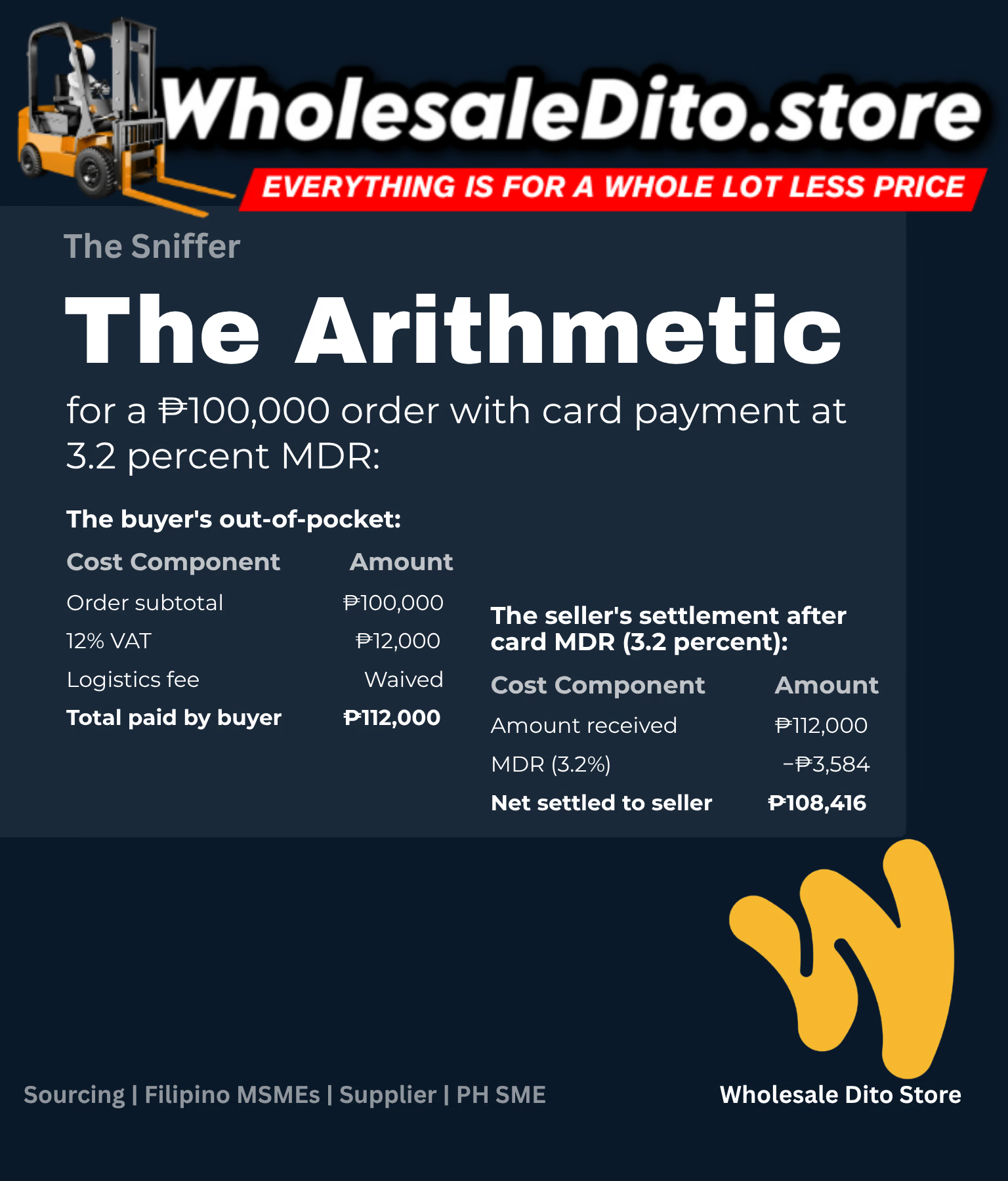
The buyer's out-of-pocket:
| Cost Component | Amount |
|---|---|
| Order subtotal | ₱100,000 |
| VAT (12%) | ₱12,000 |
| Logistics fee | Waived |
| Total paid by buyer | ₱112,000 |
The seller's settlement after card MDR (3.2 percent):
| Cost Component | Amount |
|---|---|
| Amount received from buyer | ₱112,000 |
| MDR (3.2%) | −₱3,584 |
| Net settled to seller | ₱108,416 |
The seller's settlement after QR Ph MDR (1.0 percent):
| Cost Component | Amount |
|---|---|
| Amount received from buyer | ₱112,000 |
| MDR (1.0%) | −₱1,120 |
| Net settled to seller | ₱110,880 |
Side-by-side comparison:
| Payment Method | MDR Rate | MDR Amount | Net to Seller |
|---|---|---|---|
| Card | 3.2% | −₱3,584 | ₱108,416 |
| QR Ph | 1.0% | −₱1,120 | ₱110,880 |
The buyer pays ₱112,000 in both cases. The difference to the seller is ₱2,464 per transaction. The MDR is paid by the seller, not the buyer. It is deducted from the amount settled to the merchant's bank account. The BSP mandates that the recipient of an electronic payment shall not pay for electronic crediting and shall receive the amount in full.
The Arithmetic for a Year of Orders
If a business processes ₱1,000,000 per month in orders through a card gateway at 3.2 percent MDR:
| Item | Amount |
|---|---|
| Monthly MDR (3.2% of ₱1,000,000) | ₱32,000 |
| Annual MDR | ₱384,000 |
If the same business uses QR Ph at 1.0 percent:
| Item | Amount |
|---|---|
| Monthly MDR (1.0% of ₱1,000,000) | ₱10,000 |
| Annual MDR | ₱120,000 |
The difference is ₱264,000 per year. That money stays with the merchant, not with the payment provider.
The Working Capital Value of Net Terms
If a buyer negotiates Net 30 instead of Cash Before Delivery, the buyer holds the cash for 30 additional days.
The value of that delay depends on the buyer's cost of capital. The formula:
Value of Net 30 = Order value × (Cost of capital / 365) × 30
For a ₱100,000 order and a 15 percent annual cost of capital:
| Item | Amount |
|---|---|
| Order value | ₱100,000 |
| Daily cost of capital (15% / 365) | ₱41.10 |
| Value of 30 days | ₱1,233 |
The buyer preserves ₱1,233 per ₱100,000 order by paying on Net 30 instead of Cash Before Delivery. The reader can replace the cost of capital with their own figure.
Part 4: The BIR Requirement
The Sales Invoice Under RR No. 7-2024
Under Revenue Regulations No. 7-2024, the Sales Invoice is the principal document for claiming input VAT. Official Receipts are supplementary and are not valid for input tax claims.
A compliant invoice must show:
- Seller's registered name, address, and TIN
- Buyer's registered name, address, and TIN (for sales of ₱1,000 or more to VAT-registered buyers)
- Invoice number, date, quantity, unit cost, description
- Total amount with VAT shown separately
If the invoice is missing any of the required items, the buyer may lose the input VAT credit until the invoice is corrected. Under RR No. 7-2024, the seller is liable for the non-compliance, but the buyer loses the input VAT credit if the missing information is one of the five critical items: amount of sales, VAT amount, registered name and TIN of buyer and seller, description of goods or services, or date of transaction.
Why This Matters for Payment Terms
The invoice and the payment are linked. The buyer's TIN on the invoice must match the buyer's registered name. The payment must come from an account in the buyer's registered business name where the supplier enforces a name-match rule.
A mismatch in either chain creates a reconciliation problem. The BIR requires the invoice to be correct. The supplier requires the payment to be identifiable. Both conditions have to hold for the transaction to be clean.
Part 5: How to Evaluate a Supplier's Payment Terms
The Buyer's Checklist
- What account types does the supplier offer? Some suppliers require prepayment for new accounts. Credit terms may be available after accreditation.
- What are the requirements for accreditation? SEC or DTI registration, BIR Certificate of Registration, Business Permit, valid government ID.
- Is the supplier BIR-registered? Without a BIR-registered supplier, the buyer cannot claim input VAT.
- Does the supplier issue a Sales Invoice or a Delivery Receipt? Under RA 11976, the Sales Invoice is the primary document.
- Does the supplier enforce a name-match rule? Not all do. Confirm before sending payment.
- What is the bounced check penalty, if a PDC is required? The penalty varies by supplier. Confirm in the supplier's terms.
- What is the refund process? Refunds are typically issued to the same source account. Processing time varies.
Frequently Asked Questions
What is the difference between payment terms and payment methods?
Payment methods are how money moves: bank transfer, e-wallet, card, cash. Payment terms are when money moves: advance payment, payment on delivery, Net 30.
What is the difference between Cash Before Delivery and Cash on Delivery?
Cash Before Delivery means payment is made before the order is processed for delivery. Cash on Delivery means payment is made when the goods arrive. CBD ties up working capital before shipment. COD does not.
What are the common MDR rates in the Philippines?
Published rates: QR Ph at 1.0 percent, credit and debit cards at 3.2 percent (GCash) to 3.5 percent plus ₱10 per transaction (Maya). Confirm current rates with the provider before relying on them.
What is the difference between InstaPay and PESONet?
InstaPay is real-time, up to ₱50,000 per transaction for personal transfers. InstaPay for Business supports up to ₱500,000 per transaction for registered businesses. PESONet is batch settlement, no limit.
Does the supplier need to be BIR-registered for me to claim input VAT?
Yes. The supplier must be BIR-registered and must issue a Sales Invoice with your TIN. Without this, you cannot claim the 12 percent input VAT credit.
Do all Philippine suppliers require a Post-Dated Check?
No. Some do, some do not. The practice varies by supplier, category, and account history. Confirm with the supplier before agreeing to terms.
Do all Philippine suppliers enforce a name-match rule?
No. Some do, some do not. Where it applies, the payment must come from an account in the buyer's registered business name. Confirm with the supplier.
What is Net 30?
Payment is due 30 days after the invoice date.
What is 2/10 Net 30?
A 2 percent discount is available if paid within 10 days. Otherwise, full payment is due within 30 days.
Summary
Payment methods are how money moves. Payment terms are when money moves. For MSMEs and corporate buyers, both matter.
The published MDR rates in the Philippines range from 1.0 percent for QR Ph to 3.5 percent plus ₱10 for cards. The MDR is paid by the seller, not the buyer. On a ₱117,000 order, the difference between card and QR Ph is ₱2,574.
Payment terms determine working capital. Net 30 instead of Cash Before Delivery preserves ₱1,233 per ₱100,000 order at a 15 percent cost of capital. The reader can replace the cost of capital with their own figure.
Compliance is non-negotiable. The supplier must be BIR-registered. The invoice must carry the buyer's TIN. The payment must be identifiable.
A buyer who understands both the methods and the terms can negotiate better. A buyer who understands only the methods pays more.
Related Reading
For the startup and credit-building path, see the white paper: Starting a Wholesale-Funded Business in the Philippines.
Outro
Published by The Sniffer, the strategic insights blog of Wholesale Dito Store. This article is provided as a public reference for business owners, procurement officers, and finance teams in the Philippines. Wholesale Dito Store is operated by Clickerwayne Zelle Solutions Inc, Forest Drive St., corner Country Drive, Country Homes, Biñan, Laguna 4024, Philippines. Questions can be sent to customercare@wholesaledito.store.