
Introduction
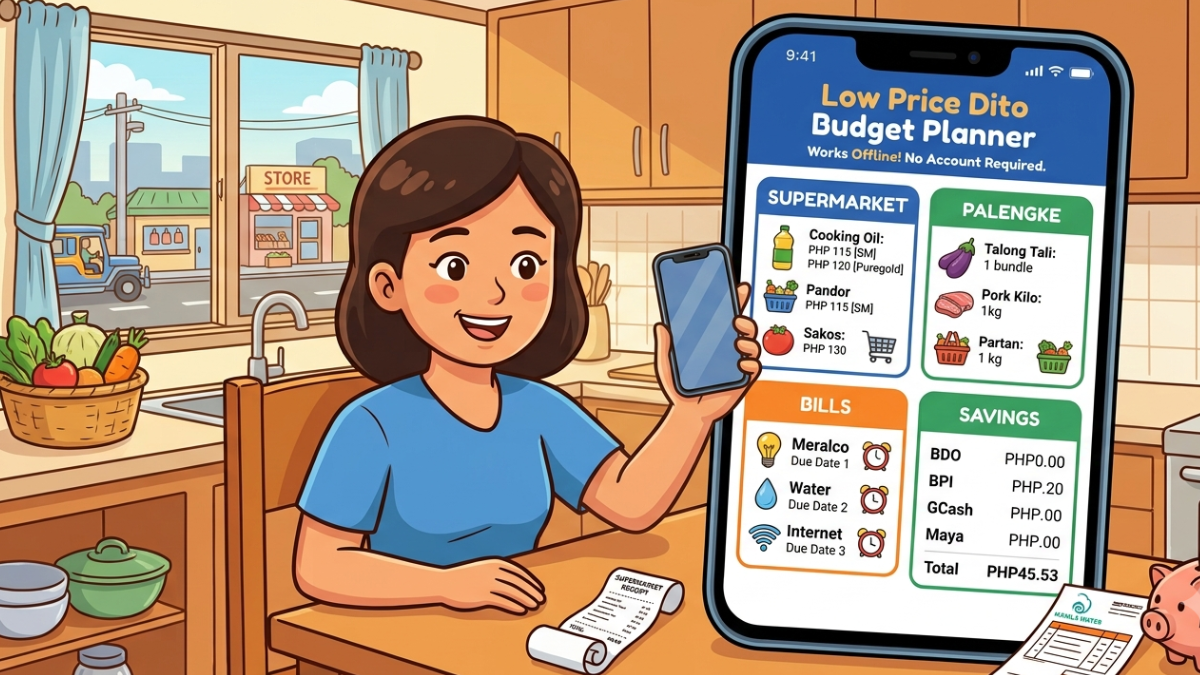
Low Price Dito has launched a free all-in-one budget planner for Filipino households. It combines grocery price comparison, palengke shopping lists, household bills tracking, and savings management in a single app. No account required. Works offline after installation.
Latest Update (July 19, 2026): The budget planner is now live at lowpricedito.com/budget-planner-philippines. It connects directly to the Low Price Dito grocery price comparison tool, allowing users to search supermarket prices and add items to their shopping list with one tap.
If you search for an all-in-one household budget planner in the Philippines that combines grocery price comparison, palengke tracking, and bills management, the results tell the story. Separate apps for separate tasks. One for scanning receipts. Another for paying bills. A third for tracking expenses. A spreadsheet for everything else. No single tool brings all four corners of Filipino household spending into one place. That gap exists because most budgeting apps are built for a different user. They are designed for general expense logging or for small business inventory. A mother planning her family meals and tracking her palengke suki prices is not the person those apps had in mind.
There is a reason this problem has persisted. Filipino household spending follows four separate rhythms. Supermarket trips on weekends. Palengke runs early morning before work. Bills on fixed dates scattered throughout the month. Savings across multiple banks and e-wallets. A tool that treats all of these as one generic expense log misses the structure that makes budgeting actually work.
A new free tool from Low Price Dito changes this. It is called the Low Price Dito Budget Planner.
You can use it here: https://www.lowpricedito.com/budget-planner-philippines
Why Filipino Household Budgeting Needs a Different Approach
A Filipino household budget planner for grocery, palengke and bills tracking needs to reflect how money actually moves through a Filipino home. These are not categories that blend together. They are four distinct rhythms with different frequencies, different units of measurement, and different consequences for getting them wrong.
Four Spending Rhythms, One Complete Picture
Supermarket groceries follow a weekly or bi-weekly cycle. Prices are printed on receipts. Store names are known. Product sizes are standardized. This data is comparable across trips and across stores.
Palengke purchases follow a different rhythm. Prices change by the hour and by suki relationship. Units are measured in kilos, bundles, and talis. Receipts do not exist. Memory fades by the time the jeepney reaches the house.
Household bills arrive on fixed dates. Meralco on the 15th. Water on the 20th. Internet on the 5th. These are predictable amounts with real consequences for late payment. They should never be lumped with discretionary spending.
Savings and ipon sit across multiple banks and e-wallets. BPI for long term. GCash for daily convenience. Maya for goal based saving. Without a consolidated view the total picture remains fragmented.
How Enterprise Procurement Principles Apply to Household Budgets
We are Wholesale Dito Store. We serve procurement teams and enterprise buyers who track every line item, compare supplier prices, and audit invoices against purchase orders. A procurement manager would never accept a financial report with a single line labeled "various expenses." Yet most budgeting tools for individuals do exactly that. They ask for an amount and a category and call it a day.
The discipline that saves corporations millions is the same discipline that can save a Filipino family thousands. The missing piece has been a tool designed for that purpose. The Low Price Dito Budget Planner applies that procurement approach to household finances.
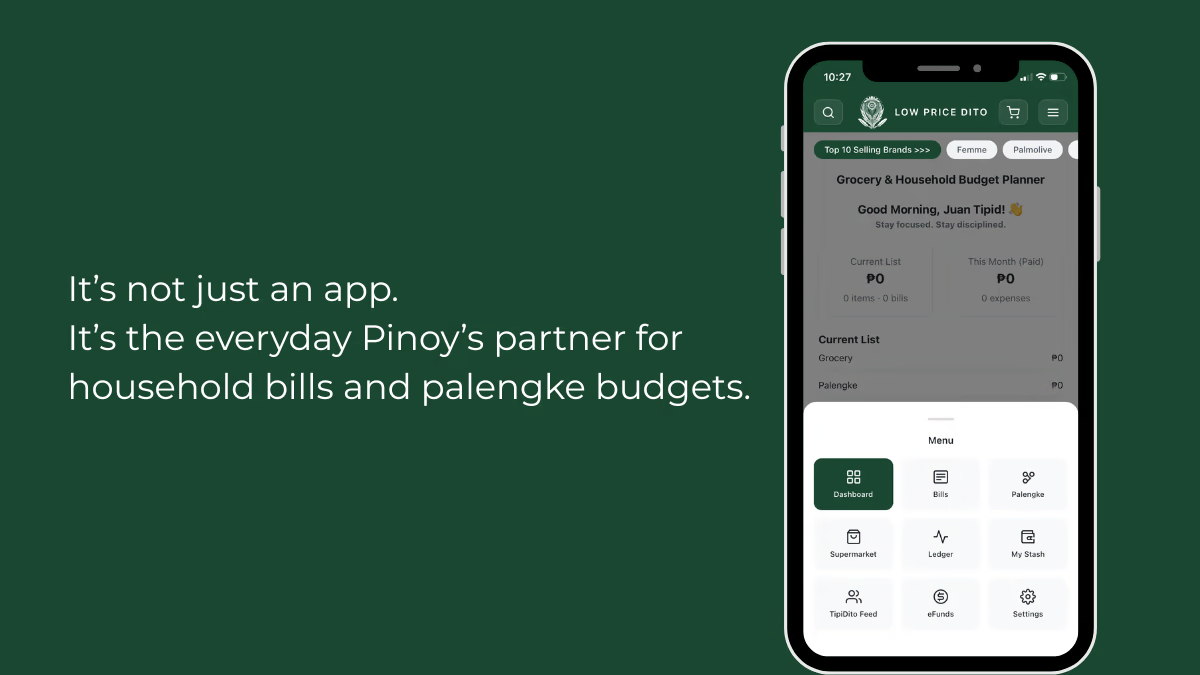
How the Four Categories Work
Supermarket list with price comparison. Users add items with product name, store, size, and price. The app connects to the same price comparison tool we wrote about in June. A user searches for cooking oil, sees which store has the best price this week, and adds the item to their list with one tap.
Palengke list with Filipino units. The wet market list uses kilo, gram, piece, bundle, and tali. These are the measurements palengke vendors actually use. The list is separate from the supermarket list so each market trip gets its own record in the spending history.
Bills tracker with due dates. Categories come pre-loaded for Philippine utilities. Meralco. Maynilad or Manila Water. PLDT or Converge. Mobile load. Rent. Insurance. Car loan. Personal loan. Tuition. Credit card. Users add due dates and the app sends reminders before bills are due. Recurring bills reload automatically each month.
Savings tracker with bank recognition. The app recognizes Philippine financial institutions by name. BDO. BPI. Metrobank. UnionBank. Landbank. PNB. Security Bank. RCBC. EastWest. China Bank. CIMB. ING. Tonik. Komo. SeaBank. GoTyme. Diskartech. GCash. Maya. When a user adds a bill category matching any of these names the app automatically creates a corresponding savings account entry. It understands that ipon and alkansya mean savings. Balances update with a tap. The total displays across all accounts.
What Separated Tracking Reveals That Combined Totals Hide
A household that lumps all spending together might think food costs are out of control. Separate tracking might show that supermarket spending is flat, palengke spending increased slightly due to rising pork prices, and the real budget pressure is coming from an internet plan upgrade. Without that clarity the family cuts the wrong expense and the problem persists.
The dual price system adds another layer of insight. Users enter a planned price when building their list. After shopping they tap the price to update it with the actual receipt amount. Items verified against a receipt display a checkmark. Over time the gap between planned prices and actual prices narrows because future budgets are based on real data rather than estimates. This is the same variance reporting used in corporate finance applied to household groceries.
The Story Behind the Tool
Clickerwayne is the technical co-founder and president of Wholesale Dito Store under Clickerwayne Zelle Solutions Inc. He is also the president and founder of Low Price Dito under Clickerwayne Holdings OPC. His corporate profile details years of experience working with the Hogan core banking system, the same platform used by major financial institutions for deposit processing, loan servicing, and general ledger reconciliation. That background explains why the budget planner applies procurement level discipline to household finances. Hogan is built on strict separation of accounts, real time transaction posting, and audit trails that track every entry from creation to final reconciliation. Those same principles structure the budget planner.
The dual price system that tracks both planned and actual spending mirrors the variance reporting used in bank financial controls. The audit flag that marks verified prices reflects the reconciliation process banks use to confirm transactions against receipts. The separation of supermarket, palengke, bills, and savings into distinct tracking categories follows the same logic as a chart of accounts in a general ledger. These are not features borrowed from other budgeting apps. They are financial controls adapted for household use by someone who spent years inside the systems that power Philippine banking. The full corporate profile is available here.
Back when he was running the business solo, there were days when Wholesale Dito Store was short on a few units needed to complete a customer's order. He had to step out, visit different supermarkets, and physically check prices just to fill urgent gaps. That frustration eventually became the grocery price comparison tool. The budget planner is the natural extension. Once you know where to find the best price, the next question is where the money actually goes.
The Technology Behind the Budget Planner
If you look at the PWA architecture of Low Price Dito, the same banking discipline is visible throughout.
- Versioned storage separates IndexedDB databases by function. API responses, product catalog, metadata, and shopping lists each have their own isolated storage. One corrupted database cannot bring down the others.
- Database integrity is verified on every startup. Read only transactions check every object store before the app serves any cached content.
- Transaction retry logic wraps every database operation. Transient locks and conflicts are handled with exponential backoff so data writes never fail silently.
- A circuit breaker pattern prevents cascading network failures. After five consecutive failures the app stops attempting network requests and serves from cache. Recovery is tested automatically every thirty seconds.
- Cache metadata is periodically reconciled. Orphaned timestamp records are removed in batches to prevent IndexedDB bloat and keep storage under quota limits.
- Storage quota is monitored proactively. When usage crosses eighty five percent the app voluntarily evicts old images to avoid forced eviction by the browser.
- Error logging has three fallback paths. IndexedDB first. PostMessage relay to open clients second. Console error third. Diagnostics survive even when the primary storage layer fails.
This is not the architecture of a casual side project. It is the architecture of someone who understands that data integrity in financial applications is not optional. The same rigor that keeps a core banking system running during peak transaction hours is applied to keeping a shopping list intact during a palengke trip with no signal.
The platform is built on a strict zero-dependency philosophy. No third-party plugins. No external scripts. No frameworks adding unnecessary weight. Just clean code engineered for speed, stability, and long-term scalability. On Google PageSpeed Insights the mobile version scored 99 out of 100 for performance. Accessibility scored 100. Best practices scored 100. SEO scored a perfect 100. These are world-class metrics for a Philippine web application.
No Account Required and Works Offline
The budget planner requires no account. No sign up. No login. No phone number. No email address unless the user chooses to set one for optional PIN recovery. All shopping lists, bills, expense history, and savings balances are stored locally on the device.
The app works offline after installation. A user standing in the middle of a palengke with no signal can still open their list, check prices, and mark items as purchased. Personal data stays on the device. Only anonymized price information is shared to help build community price comparisons across cities and provinces. No personal identity is ever attached to this data. This is not a trial version with limited features. The full tool is available to every Filipino household at no cost. No subscription. No in-app purchase. No premium tier.
How to Start Using the Budget Planner
- Open the Low Price Dito website on your phone.
- Add the page to your home screen through the browser menu. On iPhone use the Share button and select Add to Home Screen.
- Open the app from your home screen. It launches full screen like any installed app.
- Add supermarket items with store names and prices. Use the price comparison tool to find the best deals before adding.
- Add palengke items using kilo, bundle, or tali units. Keep wet market purchases separate from grocery runs.
- Enter household bills with due dates. Recurring bills will reload automatically each month.
- After shopping update prices to match your receipt. Verified items receive a checkmark.
- Mark the trip as paid to save it to your spending history. The chart updates automatically.
The spending history builds with every completed trip. Charts reveal patterns over weeks and months. A family that tracks for three months knows exactly how much to budget for the fourth. That is the difference between guessing and knowing.
For Trading Companies, Government Suppliers, and Institutional Buyers
If your company bids on government contracts through PhilGEPS, supplies other businesses, or handles procurement for an institution, this tool provides value beyond household use. Your procurement teams already understand the discipline of separated cost tracking. This same discipline applied to personal and household spending builds the instincts that make better procurement professionals. We recommend sharing this with your teams as a practical training tool for cost awareness and vendor price comparison habits.
Why We Are Telling You About This
We are Wholesale Dito Store. We serve trading companies, government suppliers, institutional buyers, and businesses that purchase in volume. You might wonder why we would point you to a household budget planner. The answer is simple. We believe the same discipline that makes a great procurement manager also makes a great household financial manager. The tools are different. The principles are identical.
We also know the person who built it. We know the standards applied. We know the banking background and the Hogan system experience. And we believe that gives us the right to recommend it.
Our Simple Recommendation
This tool exists because someone who understands your business lived the exact same frustration. Standing in a supermarket aisle. Unable to even take a photo of a price tag. Knowing there had to be a better way.
That better way is now live. The price comparison tool launched in June. The budget planner that connects to it launched in July. Both are free. Both have no ads. And together they fill a gap in the Philippine market that has been waiting for a real solution.