
Introduction
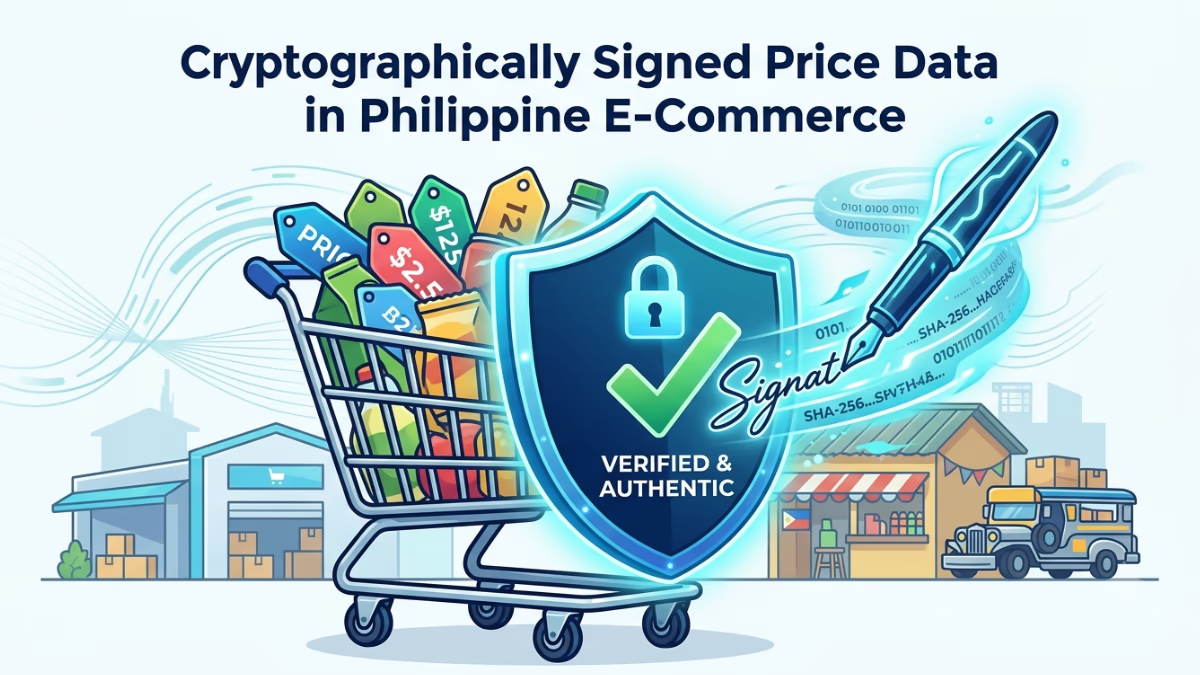
On June 21, we covered Low Price Dito's free grocery price comparison tool. The site itself launched on August 13, 2023 and has operated as a retail e-commerce platform since. A budget planner is scheduled to launch on July 19, 2026. Today, Clickerwayne, the Technical Co-Founder and President, shipped something different: a provenance engine that cryptographically signs every page on the site.
By mid-July, the same provenance infrastructure will be active on this site, Wholesale Dito Store, making it the first B2B wholesale platform in the country to cryptographically sign its product listings. The corporate relationship between the two platforms and the hybrid retail-aggregator model of Low Price Dito have been covered in our previous articles. What is new today is the verification layer now backing every page across the platform.
Choosing data integrity over AI integration
While companies across Southeast Asia are adding AI chatbots and generative features to their websites, Clickerwayne, the Technical Co-Founder, President and developer behind both platforms, took the opposite approach. No AI integration. No automated product descriptions. Instead, the focus is on making sure that when AI systems do retrieve data from either site, that data can be independently verified as authentic.
The reasoning is grounded in a fundamental flaw in how language models operate. These systems generate text by predicting the next most probable word based on statistical patterns in their training data. They do not evaluate truth. They evaluate likelihood. Clickerwayne points out that when you ask an AI a question, you can expect one of these outcomes:
3 Common AI Responses
- Fact: A real and true answer drawn from accurate source material.
- Fabrication: The AI produces a completely hallucinated answer with no basis in reality.
- Factrication: A term coined by Clickerwayne. The AI combines real facts with fabricated information, blending truth and falsehood into a single response that sounds plausible but is partially or significantly wrong. This is the most dangerous of the three.
A price comparison query illustrates the problem. If multiple sources report different prices for Zachem Dishwashing Liquid, a language model cannot determine which one is current. It might pull a real price from one source, combine it with a hallucinated store name from another, and present the result with confidence. The user receives a factricated answer, partly true, partly invented, with no way to tell which part is which.
The provenance engine addresses this by removing ambiguity entirely. Instead of asking an AI to sort through conflicting web pages, the system provides structured, timestamped, cryptographically signed data. A crawler that retrieves a manifest file can verify the signature against a public key. If the signature passes, the data is authentic and unaltered. If it fails, the data is discarded. There is no gray area where factrication can take root.
How the provenance system works
A script generates a manifest for each publicly active page across the entire Low Price Dito site. At last count, that is 163 public pages. These include:
- Product pages for items Low Price Dito sells directly through its retail storefront
- Informational pages like the about page
- The comparison tool where users monitor supermarket prices
- The upcoming budget planner that helps households calculate weekly expenses
Every page gets signed, not only the price data. Wholesale Dito Store pages will be added to the same system by the middle of this month.
Each manifest contains:
- Assertions about the page
- A SHA-256 hash of the content
- A timestamp
- An ECDSA signature generated using the P-256 curve
Before signing, the data is canonicalized so that key ordering does not affect the signature output. The resulting file is stored in a public directory at https://www.lowpricedito.com/.well-known/provenance/manifest-index.json.
The directory contains several publicly accessible files:
- A schema file so validators know what structure to expect
- A master index listing every manifest
- A revocation list for any manifest later found to contain errors
- A timestamp authority file tracking the lifecycle of the signing key
All of these are accessible without login or registration. Anyone with basic scripting knowledge can download the public key, fetch any manifest, and verify the signature independently.
First of its kind
Claim: Based on available information, Low Price Dito is the first retail e-commerce platform in the Philippines to implement cryptographically signed data with a publicly verifiable provenance chain across its entire site. Wholesale Dito Store will become the first B2B wholesale platform in the country to do the same when the system goes live here later this month.
This is not a claim about market share or revenue. Low Price Dito is a small hybrid retail operation. Wholesale Dito Store serves business buyers as the wholesale division of the same group. The claim is narrower and more specific: no other Philippine e-commerce platform, large or small, currently offers cryptographic proof that its page content matches what was recorded at the time of signing, with a revocation system and timestamp authority in place for independent verification.
What this means for both platforms
Low Price Dito serves individual consumers through its retail store, comparison tool, and upcoming budget planner. Wholesale Dito Store serves businesses purchasing in bulk. The two platforms address different markets but will share the same data integrity standard.
The price fluctuation tracking announced on June 29 is currently in its initial rollout. Once fully operational, it will let users see whether a product's price has changed compared to the previous week. Each weekly price point will be backed by its own signed manifest, so as the data accumulates week by week, an auditable trail forms. A consumer questioning whether a past price was accurate or a business buyer verifying wholesale pricing on Wholesale Dito Store will have the same option: check the manifest from that date.
The bigger picture
The Philippine e-commerce sector is growing quickly, but discussions about data quality tend to focus on update frequency rather than verifiability. Price comparison sites, deal aggregators, and grocery platforms all display numbers and ask users to trust them. None currently provide cryptographic proof.
Low Price Dito now does, across every page on the site. Wholesale Dito Store will soon follow. That does not guarantee every price matches the shelf or the wholesale invoice. It guarantees something narrower but more defensible: the content displayed matches what was recorded at the time of signing, and nobody tampered with it afterward.
The platform was launched in August 2023. The comparison tool was covered here on June 21. The budget planner arrives July 19. And now, a provenance engine ties it all together with a verifiable chain of trust. By mid-July, the same infrastructure will span both the retail and wholesale sides of the operation.
Notes
About the platforms: The corporate structure and hybrid retail-aggregator model were detailed in our earlier coverage. The provenance engine is version 1.5 of Clickerwayne-Provenance-Engine. All manifests, schema, revocation list, timestamp authority, and public keys are available at https://www.lowpricedito.com/.well-known/provenance/manifest-index.json. Wholesale Dito Store will be added to the same system by mid-July 2026. No account or special access is required.
Disclosure: The term "factrication" and its definition were coined by Clickerwayne to describe the phenomenon where AI language models combine factual information with fabricated data, producing responses that are partially true and partially invented. The concept is central to the design philosophy behind the provenance engine described in this article.