

In Brief
- Most sari-sari store owners price by feel, not by math. They add a peso or two to whatever the product cost. On a ₱5 item, that is a 20% markup. On a ₱45 item, that is a 2.2% markup. The second one loses money.
- Markup is not margin. A 30% markup is a 23% margin. Confusing the two is the most common pricing mistake in Philippine micro-retail.
- Not every piece gets sold. Some stay on the shelf. Some get damaged. Some expire. Every unsold piece is money the owner spent but did not recover.
- Not every utang gets paid. Some customers take weeks. Some never pay. Treating this as misfortune instead of a predictable cost is what collapses the cash flow.
- This article lists the common mistakes and the fixes. The Ask W Calculator [Not AI] Sari-Sari Store Profit Calculator computes them.
Direct Answer
Most sari-sari store owners work hard and still do not make money. The reason is not effort. It is that the pricing, the losses, and the credit are all guessed instead of measured. A store that prices by feel, ignores unsold stock, and treats utang as bad luck will lose money even when it is busy.
The fix is arithmetic. Price by margin, not by feel. Count the pieces that do not sell. Set an utang allowance. The difference between a store that guesses and a store that measures is the difference between surviving and scaling.
Who This Is For
This article is for sari-sari store owners, tindahan operators, and small retailers in the Philippines. It is also for anyone thinking of opening one.
It is not for:
- Establishments using full POS systems with staff and inventory software.
- Retail chains with dedicated accounting.
- Online sellers on Shopee or Lazada. The math is different. The platform fees are a separate topic.
Why This Matters
Sari-sari stores are the largest retail network in the Philippines. More than a million of them serve more than 90 percent of Filipino consumers. Almost all are owner-operated. Almost all price by feel.
There is nothing wrong with feel. But feel cannot see the difference between a 20% margin and a 2% margin. It cannot see that a fast-selling product is losing money. It cannot see that the utang is eating the capital. These are numbers, not intuition.
The stores that survive and grow are the ones that measure. The rest are the ones that work hard and wonder why the drawer is always empty.
Mistake 1: Pricing by Feel Instead of by Margin
The most common method is to add a fixed peso amount to whatever the product cost. Buy at ₱10, sell at ₱12. Make ₱2. That feels consistent.
It is not. A ₱2 markup on a ₱10 item is a 20% markup. A ₱2 markup on a ₱45 item is a 4.4% markup. After transportation to the wholesaler and the time spent, the second one loses money.
The fix: Price by margin, not by feel. Decide what percentage of the selling price you want to keep as profit. Then compute the price from that.
For a product that costs ₱10 and a target margin of 20%, the selling price is ₱10 / 0.8 = ₱12.50.
The Sari-Sari Store Profit Calculator has a "Find the Price" mode that does this. Enter the cost, enter the profit you want per piece, and it returns the price.
Mistake 2: Confusing Markup with Margin
Markup and margin describe the same profit from different bases. Markup is profit as a percentage of cost. Margin is profit as a percentage of selling price. They are never the same number.
| Markup | Margin |
|---|---|
| 10% | 9.09% |
| 20% | 16.67% |
| 25% | 20.00% |
| 30% | 23.08% |
| 40% | 28.57% |
| 50% | 33.33% |
| 100% | 50.00% |
Markup is always higher than margin for the same profit. If a supplier says "30% markup" and the owner hears "30% margin," the owner is off by 6.92 percentage points. On a ₱100 product, that is ₱6.92 per piece. Over a year, it is a meaningful amount of money.
The fix: Use margin for pricing decisions. Use markup only when the supplier is quoting it. The calculator shows both, side by side, so the difference is visible.
Mistake 3: Ignoring Unsold Pieces
Not every piece gets sold. Some stay on the shelf too long. Some get damaged. Some expire. Some get eaten at home. The owner paid for all of them, but only the sold ones come back as money.
If the owner buys 24 sachets and sells 20, the 4 unsold pieces are a 16.7% loss on the batch. If the margin was 20% and the loss is 16.7%, the real margin is 3.3%. Almost nothing.
The fix: Count the pieces that do not sell. Subtract them from the batch before computing profit. The calculator does this in the "Check the Profit" mode.
The three-option dropdown asks: "When you buy that many, do you usually sell all of them?" Yes, sometimes, or no. The answer maps to a loss rate: 0%, 10%, or 25%. For owners who want precision, a fourth option allows any number from 0 to 100.
Mistake 4: Treating Utang as Bad Luck
Every sari-sari store has customers who take utang. Some pay on time. Some take weeks or months. Some never pay. The owner usually treats the unpaid portion as misfortune. It is not. It is a predictable cost of doing business in a neighborhood.
The fix: Set an utang allowance. Decide how much you are willing to lose each month. Subtract it from your total profit. The number that remains is the real profit.
The calculator has a single field for this, applied at the store level, not per product. It is a decision, not a prediction. The owner sets the limit. The customer does not.
Mistake 5: Not Knowing the Break-Even Point
When the owner buys a batch of 12 pieces at ₱10 each, the total cost is ₱120. If the selling price is ₱15 per piece, the owner must sell 8 pieces just to recover the ₱120. The remaining 4 pieces are the profit.
If the owner sells only 7 pieces, the batch lost money. If the owner sells 8, the batch broke even. If the owner sells 9, the batch made a small profit.
Most owners do not know this number. They sell until the stock is gone and hope for the best.
The fix: Compute the break-even point before the batch is sold. The calculator shows it directly: "You must sell 8 of 12 pieces to break even. The remaining 4 are your profit."
That one number changes how the owner thinks about a batch. It turns "sell as much as you can" into "sell at least 8 pieces before anything else counts."
Mistake 6: Mixing Capital with Spendable Cash
Cash comes into the drawer all day. The owner uses it for groceries, school baon, and the electric bill. When restock day comes, the money is gone. The owner buys smaller quantities at higher per-piece prices. The cycle repeats.
The fix: Separate the capital from the profit. The capital is what buys the next batch. The profit is what the owner can spend.
The calculator shows profit per batch, profit per week, and profit per month. It does not track the drawer. But knowing the number is the first step to keeping the capital intact. An owner who knows they made ₱108 this week can decide how much of it to reinvest.
Mistake 7: Not Adjusting for Supplier Price Increases
Suppliers raise prices. Inflation raises prices. Rice goes up. Sugar goes up. Cooking oil goes up. The owner keeps selling at the old price because the suki (regular customer) expects it. The margin shrinks, then disappears.
The fix: When the supplier raises the price, compute the new selling price immediately. The calculator has a "Cost Change Check" mode. Enter the old cost, the new cost, and the current selling price. The tool shows the old margin, the new margin, and the price required to keep the same margin.
An owner who adjusts within a week loses a week of margin. An owner who adjusts within a month loses a month. An owner who never adjusts loses the business.
Mistake 8: Not Knowing Which Products Are Worth Keeping
A sari-sari store sells 50 to 200 different items. Some are profitable. Some are not. Without measurement, the owner cannot tell which is which.
A product that sells fast with a thin margin may make less money than a product that sells slowly with a healthy margin. The owner who judges by "what sells" will keep the wrong products and drop the right ones.
The fix: Compare products side by side. The calculator has a "Compare Products" mode. Enter up to several products with their costs, prices, batch sizes, and turnover. The tool ranks them by monthly profit. The lowest-ranked product is the candidate for dropping.
How This Compares to Other Tools
Most tools available for small business in the Philippines fall into three categories. None of them are built for the sari-sari store.
| Tool | What it does | What it misses |
|---|---|---|
| Generic markup calculators | Compute margin and markup | No utang. No unsold stock. No batch logic. |
| Mobile POS apps | Track sales and inventory | Require download, account, setup. Track transactions, not pricing decisions. |
| Spreadsheets | Customizable | Poor on mobile. Require manual formula building. Not written for a store owner. |
| Ask W Sari-Sari Calculator | Pricing, profit, break-even, utang, cost change | No inventory tracking. No transaction log. Runs in the browser, no account. |
The Ask W [Not AI] Calculator is not a POS. It is not an inventory system. It is a pricing and profit tool. It answers three questions in under 10 seconds:
- "If I buy this at ₱X, what price should I tag each piece?"
- "How many do I have to sell before I break even on this batch?"
- "Is this product actually making me money after unsold pieces and utang?"
It is free. It requires no registration. It works offline. It runs on any phone browser.
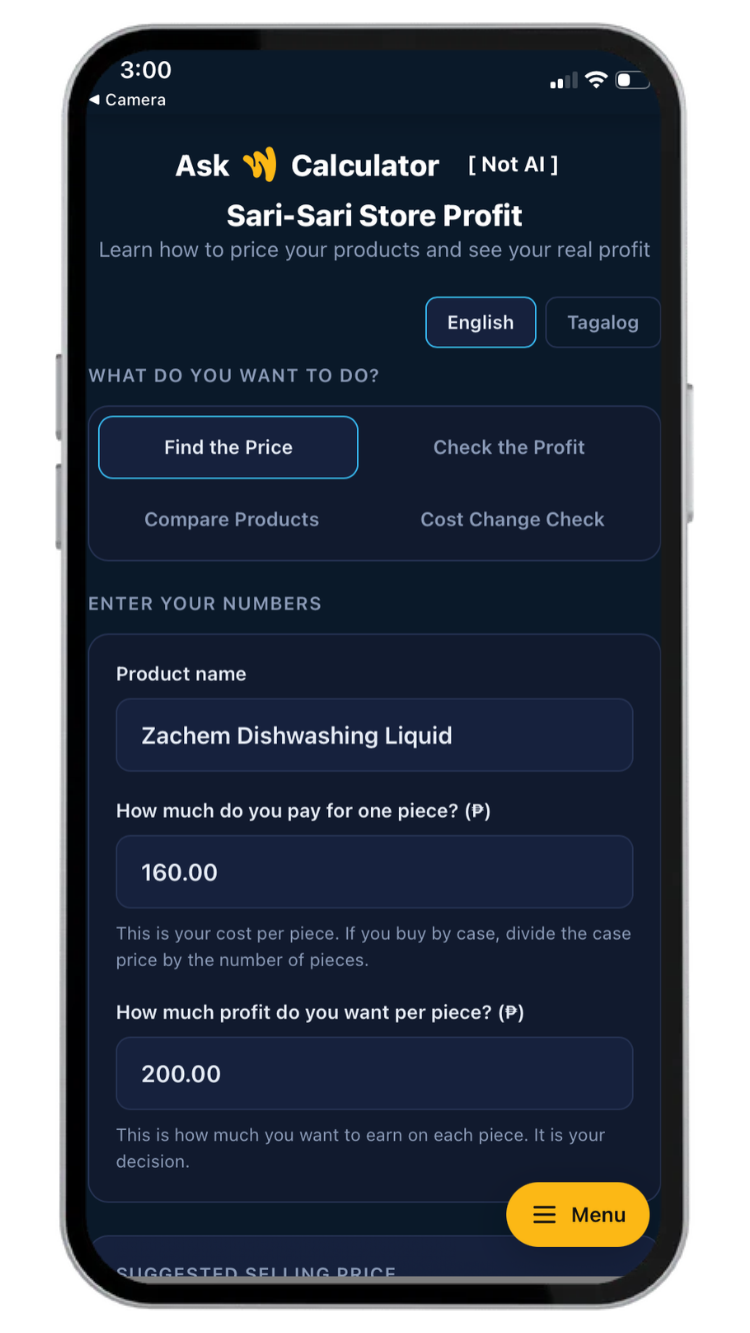
This tool is not a replacement for your notebook. The notebook is faster for logging daily sales and customer utang. This tool is for the moment before you buy: when you need to know what price to tag, how many pieces must sell to break even, and whether the product is worth carrying at all. The two work together.
What Scaling Looks Like
A sari-sari store does not scale by adding more products. It scales by knowing which products to keep, which to drop, and which to price higher.
Three things happen when an owner starts measuring:
- Slow losers get dropped. The product with the 2% margin that has been sitting on the shelf for months gets cut. The capital moves to a product that actually earns.
- Fast winners get promoted. The product with the 20% margin and quick turnover gets a bigger allocation. The owner buys more of it and less of everything else.
- Prices adjust. The product that was priced by feel gets repriced by margin. Some prices go up. A few go down. The average margin improves.
None of this requires new capital. It requires knowing the numbers. That is what the calculator provides.
What the Calculator Does Not Do
The Ask W [Not AI] Sari-Sari Store Profit Calculator is an estimator. It does not handle every case. Specifically, it does not handle:
- Inventory tracking. The owner still counts stock manually.
- Transaction logging. It is not a POS.
- Customer utang ledgers. It models utang as a store-level allowance, not a per-customer list.
- Electricity, rent, transportation, or other overhead. The tool computes product-level profit, not store-level profit.
- Taxes, permits, or BIR filings. For those, use the Ask W [Not AI] BIR Tax Estimator or consult a CPA.
For anything outside the scope, consult a business counselor or a CPA.
Frequently Asked Questions
What is the difference between markup and margin?
Markup is profit as a percentage of cost. Margin is profit as a percentage of selling price. A product that costs ₱10 and sells for ₱15 has a markup of 50% and a margin of 33%. Markup is always higher.
Why do unsold pieces matter?
Every unsold piece is money spent but not recovered. If a batch of 24 pieces has 4 unsold, that is a 16.7% loss. If the margin was 20%, the real margin after the loss is 3.3%.
What is an utang allowance?
The utang allowance is the amount the owner decides to set aside each month for unpaid or slow-paid credit. It is a decision, not a prediction. The calculator subtracts it from the total profit.
Does the calculator need an account?
No. It runs in the browser. No registration. No login. No server.
Does it work offline?
Yes. After the first visit, the calculator works without internet. The numbers are saved on the device.
Is the calculator available in Tagalog?
Yes. There is a language toggle at the top. English and Tagalog.
What is a good margin for a sari-sari store?
It depends on the product. Fast-moving items like sachets and drinks usually carry 8% to 15% margin. Slow-moving items like batteries or canned goods carry 15% to 25%. The right number depends on the product and the neighborhood.
What if a product is not selling?
If it has been on the shelf for months and the batch has not cleared, the product is a candidate for dropping. Use the Compare Products mode to see the monthly profit ranking. The lowest-ranked product is the first to cut.
Does the calculator use AI?
No. It uses standard arithmetic. Every result can be reproduced by hand. There is no AI, no inference, and no interpretation.
Where is the calculator?
The Ask W [Not AI] Sari-Sari Store Profit Calculator is at wholesaledito.store/ask-w/calculator-sari-sari-store-profit.
Summary
Most sari-sari store owners work hard and still do not make money. The reason is not effort. It is that the pricing, the losses, and the credit are guessed instead of measured.
The eight mistakes in this article are all arithmetic. Pricing by feel instead of margin. Confusing markup with margin. Ignoring unsold pieces. Treating utang as bad luck. Not knowing the break-even point. Mixing capital with spendable cash. Not adjusting for supplier price increases. Not knowing which products are worth keeping.
The Ask W [Not AI] Sari-Sari Store Profit Calculator addresses all eight. It is free, browser-based, and works offline. No registration. English and Tagalog.
The store that measures is the store that survives. The store that guesses is the store that works hard and wonders where the money went.
Outro
Published by The Sniffer, the strategic insights blog of Wholesale Dito Store. This article is provided as a public reference for sari-sari store owners and small retailers in the Philippines. Wholesale Dito Store is operated by Clickerwayne Zelle Solutions Inc, Forest Drive St., corner Country Drive, Country Homes, Biñan, Laguna 4024, Philippines. Questions can be sent to customercare@wholesaledito.store.