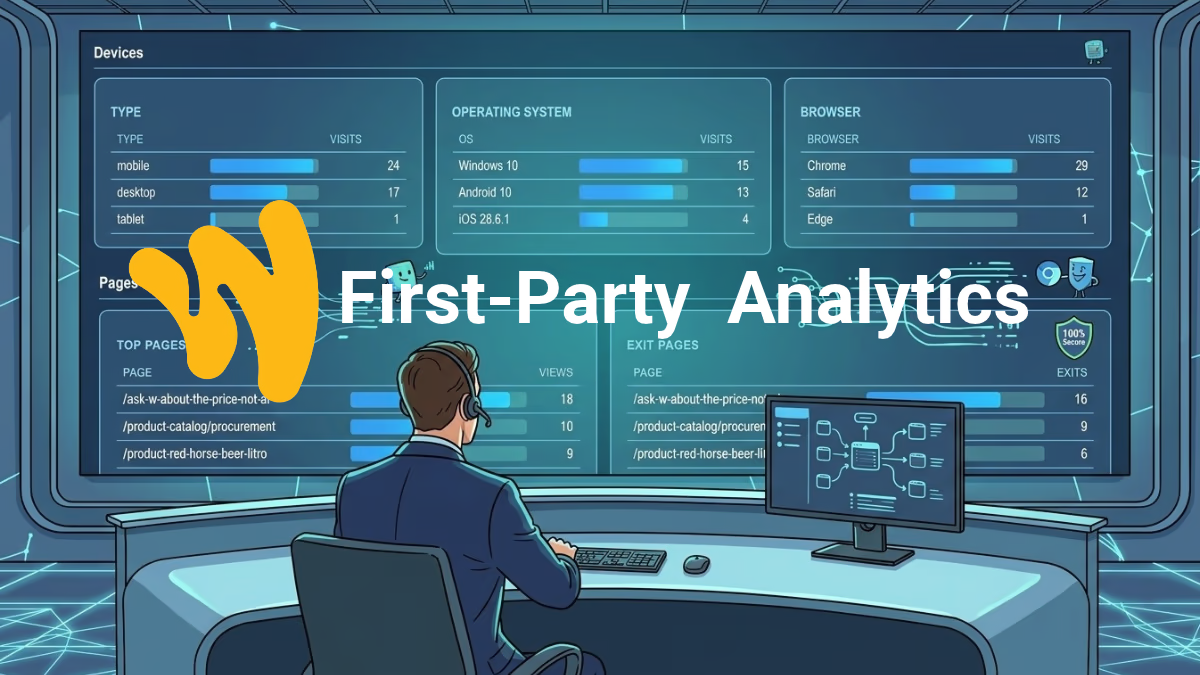
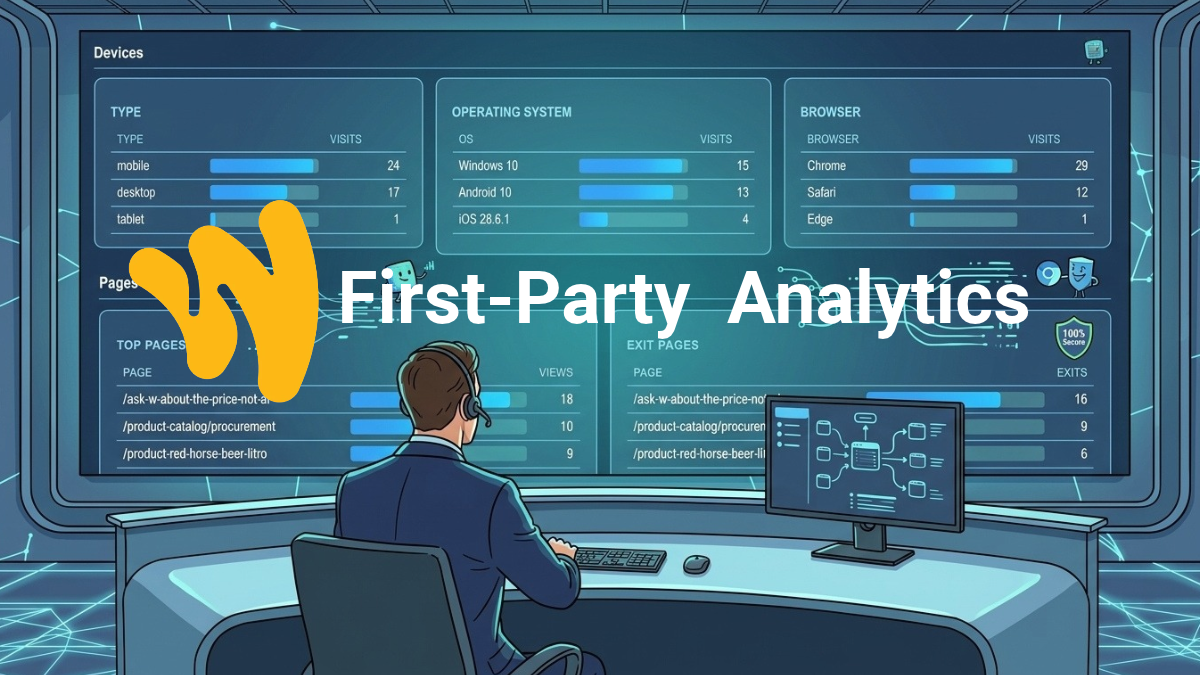
At A Glance
We moved our analytics off third-party tools on September 13, 2026. The database now lives on our own server. Clickerwayne Enterprise was registered as a DTI sole proprietorship on December 28, 2010. The Wholesale Dito Store brand was established under Clickerwayne Enterprise on December 29, 2021. Clickerwayne Zelle Solutions Inc was registered with the SEC on June 27, 2023, and assumed full ownership of the brand. The corporation is classified under Information Technology as its primary scope and Wholesale Trade as its secondary scope. Four days after the analytics migration, we had enough data to see one thing we had already broken and one thing we had not noticed. This is a write-up of what we found.
Methodology
The window is four days, starting September 13, 2026. The database holds 52 sessions from 37 unique visitors across 110 pageviews. This is a post-migration baseline, not a trend line. The old analytics database is still intact and used internally for comparison. It is not part of this write-up.
Two cookies are set. _wds_consent holds the accept or reject choice. _wds_aid is an anonymous 64-character string used to count unique visitors and stitch pageviews into sessions. Nothing else is loaded. No Google Analytics, no DoubleClick, no Facebook Pixel. Every script, image, and stylesheet is served from wholesaledito.store. Details are in the Cookie Policy and Privacy Policy.
Everyone in this dataset accepted the banner. The reject path is not visible here, by design. We cannot calculate an accept rate from this data alone. That is on the list to fix.
Key Facts
- Site:
wholesaledito.store - Operator: Clickerwayne Zelle Solutions Inc
- Enterprise registered (DTI): December 28, 2010
- Brand established: December 29, 2021
- Corporate entity registered (SEC): June 27, 2023
- Analytics type: self-hosted, first-party only
- Cookies set: 2 (
_wds_consent,_wds_aid) - Third-party analytics: none
- Third-party scripts: none
- Measurement window: 4 days, from September 13, 2026
- Sessions in dataset: 52
- Unique visitors in dataset: 37
- Pageviews in dataset: 110
- Device split: mobile majority, desktop minority
- Traffic sources: Google majority, direct and internal secondary
- Top page by views and exits:
/ask-w-about-the-price-not-ai - Defect caught: empty
?q=on price inquiry input - Defect fix:
requiredattribute added, same day - Compliance basis: RA 10173, GDPR where applicable
- Delivery area: Metro Manila, Laguna, Cavite, Batangas
- Appendix data table: First-Party Analytics Data: 4-Day Launch Baseline
4-Day Metrics at a Glance
The facts above describe the site and the analytics setup. The tables below describe the 4-day measurement window only. All figures are from the September 13 to September 17, 2026 baseline.
| Metric | Value |
|---|---|
| Unique visitors | 37 |
| Sessions | 52 |
| Pageviews | 110 |
| Pages per session | 2.12 |
| Average session | 1m 26s |
| Bounce rate | 59.5% |
| Returning visitors | 0.0% |
Traffic sources
| Source | Sessions | Share |
|---|---|---|
| google_shopping | 16 | 30.8% |
| wholesaledito.store (internal) | 12 | 23.1% |
| direct | 11 | 21.2% |
| google.com (organic) | 8 | 15.4% |
| other | 5 | 9.6% |
Device type
| Type | Sessions | Share |
|---|---|---|
| Mobile | 32 | 61.5% |
| Desktop | 20 | 38.5% |
Top pages by views
| Page | Views | Exit Rate |
|---|---|---|
/ask-w-about-the-price-not-ai | 18 | 88.9% |
/product-catalog/procurement | 10 | 90.0% |
/product/red-horse-beer-litro | 9 | 66.7% |
Geography by region (Top 5)
| Region | Sessions | Share |
|---|---|---|
| Metro Manila | 11 | 21.2% |
| Laguna | 10 | 19.2% |
| Davao del Sur | 7 | 13.5% |
| Cavite | 6 | 11.5% |
| Cebu | 3 | 5.8% |
The full breakdown by operating system, browser, city, and exit page is available in the 4-Day Launch Baseline appendix.
What the Launch Data Showed
Traffic mix
Google sent the most traffic. Google Shopping and Google organic together made up just under half of all sessions. Direct visits and internal navigation followed, with direct slightly ahead. ChatGPT sent one referral, and one session carried a Facebook Ads tag.
We do not run Facebook ads. We do not work with an ad agency. We traced the tag to a fbclid parameter on a shared link. Facebook appends fbclid to any outbound click from its platform, paid or not. Our analytics tool interpreted that parameter as a Facebook Ads source. It was not. We are correcting the source label.
The ChatGPT referral is the first one we have seen. One session is not a pattern. But it is the kind of signal that makes answer-engine optimization and generative-engine optimization worth doing.
Device split
Mobile was 61.5% of sessions. Desktop was the rest. Chrome was the dominant browser, Safari second. Windows 10 was the most common operating system. Android 10 alone was more than a quarter of sessions, which matters because we test the PWA on Android 10 and it is an older release. iOS versions were spread across six generations in four days.
Geography
Metro Manila and Laguna together were about two out of every five sessions. Davao City sent more traffic than any other city outside our delivery area. We do not deliver to Davao. The traffic is real, we just cannot serve it. Cavite, which is next to Biñan, sent less than we expected. International traffic from Shanghai, Singapore, Hanoi, Islamabad, Abuja, and Shenzhen added up to a small share. Most of it is likely research, bot, or misattributed traffic.
Top pages
Ask W About The Price [Not AI] was the most visited page and the most common exit page. Roughly nine in ten views on that page ended the session. The catalog came next, with a similar exit rate. A delisted product page for Red Horse Beer Litro was third. The homepage did not break the top three.
That is the pattern worth staring at. Our two busiest pages are also our two biggest drop-off points. People arrive, look at one thing, and leave.
What the Data Caught
The empty query parameter
On September 17, 2026, at 18:37:09, the database logged a pageview to /ask-w-about-the-price-not-ai?q=. The query was empty. The page itself says "Enter at least 3 characters to search," so an empty submission should not have been possible. It was, because the input field had no required attribute. The fetch button fired with nothing in the box and sent the visitor to a page with no results.
We added the required attribute the same day.
This is what owning the database buys you. The defect was invisible to the user beyond a blank page. It did not throw an error. It did not crash. It left a URL in our logs that should not have existed. Because we store the full URL, including query strings, we could see it the moment it happened. A vendor tool would have shown the same event eventually, but we would have had to export it or wait for a report. We had it in front of us and fixed it that day.
We wrote about this class of problem before in Ask W Direct [Not AI]: The Antidote to Factricated Search. This is a follow-up.
The exit pattern
The price tool and the catalog both have exit rates above 89%. That is not a bug. It tells us something about intent. The people landing on those pages come from Google Shopping and Google organic. They are not browsing. They are checking one thing.
We are looking at three changes. First, whether the price tool should link into the RFQ flow at the end of a query. Second, whether the catalog page needs a clearer next step. Third, whether delisted product pages should redirect harder toward active alternatives.
Delisted pages still earn their keep
We keep delisted product pages live on purpose. Red Horse Beer Litro and Sting Energy Drink Original 290mL are no longer sold, but the pages still rank on Google Shopping and Google organic. They bring in traffic we would otherwise pay to reach. The Add To List button on those pages is gray, disabled, and labeled Delisted. Nobody can complete a purchase on a product we do not sell. But the page still does its discovery job. The data supports keeping it.
What the Data Cannot Tell Us
We do not track clicks inside a page. No scroll depth, no form-field interaction, no time-on-element. We know a page was opened and how long it stayed open. We do not know what the visitor did while it was open. That means we cannot say whether someone on a delisted product page tried to click the disabled Add To List button. We cannot say whether someone on the price tool scrolled past the fold. We cannot say which field on the RFQ form caused a drop-off.
There is also the consent wall. Visitors who reject the banner do not appear in this dataset. We cannot compare accepters to rejecters. We cannot compute an accept rate. We are adding a separate accept/reject counter on the banner itself, no identifier attached. That will let us state the accept rate as a fact in a future write-up instead of guessing.
Sample size is the third limit. 52 sessions over 4 days is a baseline. Percentages on a base that small move around. Treat the numbers as directional.
What We Are Doing With It
Three changes are already queued.
The consent banner gets a separate accept/reject counter. No identifier, no cookie, just a tally. Once it is live, we can answer the accept-rate question honestly.
The price tool and the catalog get a review for clearer next steps. The RFQ system is already automated. The write-up on how it works is in On-Demand Request For Quotation: Get Bulk Price Quotes Instantly. The problem was never the RFQ. It is the path from a price check to an RFQ.
The last change flows back into the PWA and the analytics stack. The offline behavior, including the /offline fallback and the IndexedDB catalog, is documented in PWA v6 - Synchronicity. The analytics database is a separate service on the same infrastructure. Every change to one gets reviewed against the other.
Two older write-ups give the background. Why Our B2B Site Looks Plain But Runs Serious Engineering covers the stack. The Secure Wholesaler: A Data Protection Case Study from Wholesale Dito Store covers the data protection posture. And The Danger Google's AI Just Revealed explains why we think first-party data matters more now than it did two years ago.
What This Means for Other B2B Wholesalers
If you run a B2B site in the Philippines and you are still on a vendor analytics product, you are not doing anything wrong. But three things are harder for you than they should be.
You cannot see URL-level defects in real time. You cannot join analytics records to your own RFQ, requisition, or verification data without exporting through a vendor. And you cannot easily make analytics respect the same privacy standard you already apply to your customers' business documents.
You do not have to build the whole stack on day one. Start with two cookies, one pageview table, and one session view. That was enough for us to catch a real defect in four days.
Frequently Asked Questions
What is first-party analytics?
First-party analytics is a setup where the site owner stores visitor data on their own infrastructure. No vendor sits in the middle. Nothing is shared with advertisers or data brokers. Wholesale Dito Store runs this kind of setup on its own server, with two cookies: _wds_consent for the banner choice and _wds_aid for an anonymous identifier.
What exactly gets recorded when I accept the cookie?
An anonymous 64-character cookie ID. The page URL and title. The referrer, when the browser sends it. Time on page and visit timestamp. The IP address, used only to work out the city. The user agent string, which tells us browser, operating system, and device type. Any traffic source tag in the URL.
No names. No emails. No phone numbers. Nothing that points back to a specific person.
What if I reject?
The analytics cookie is never set. Nothing is recorded. The only cookie that stays is _wds_consent, which remembers your choice for seven days so the banner stops appearing. The product pages, pricing, and procurement features all keep working. The only thing that changes is that we cannot measure your visit.
How did the empty query defect get caught?
The database stores the full URL of every pageview, including query strings. When someone submitted an empty search on the price tool, the resulting pageview landed in the log as /ask-w-about-the-price-not-ai?q= with an empty value. That URL was not reachable through normal use. It pointed straight at the missing required attribute. We added it the same day.
Is this compliant with RA 10173?
Yes. The setup follows the Philippine Data Privacy Act of 2012 and, for visitors from the European Economic Area, the GDPR. Analytics runs on explicit consent. You can withdraw by clearing the _wds_consent cookie. Details are in the Cookie Policy and Privacy Policy.
Why are delisted product pages still online?
They still bring traffic. Products like Red Horse Beer Litro and Sting Energy Drink Original 290mL are no longer sold, but their pages rank on Google Shopping and Google organic. The Add To List button on those pages is disabled and labeled Delisted, so no one can complete a purchase on a product we do not carry. The pages earn discovery traffic. We keep them for that reason.