In Brief
- This article explains why a B2B supplier might maintain a Facebook page but post to it rarely. For us, that is a deliberate decision, not neglect.
- In our observation, social platforms suppress posts that lead users away from the platform. A link is not required for this to happen. The platform's interest is in keeping users inside the app, and any post that draws attention outward runs against that interest.
- A post, not just a website, can be indexed by search engines. In our observation, this means a public post can appear in search results and take the click that would otherwise have gone to the site. The searcher lands on the platform, not on the store.
- Social content has a short lifespan. An indexed article can keep working for years. A calculator or reference tool belongs where it can be found by active intent, not in a feed built for passive scrolling.
- This article reflects years of direct observation by our technical co-founder, not a controlled study. Where we state a platform behavior, we are stating what we have observed, not a measured result.
Direct Answer
A B2B supplier does not post much on social media because, in our observation, it does not serve the goals the platform was built for us to serve.
Social platforms are built to keep users inside the platform. A post that sends a user somewhere else works against that design. In our observation, posts that draw attention outward are shown to fewer people than posts that keep attention inside. This happens whether or not the post contains a link. The platform's interest is not in the post. It is in the session.
There is a second effect. A public post can be indexed by search engines. When it is, a person searching for a relevant term may see the platform's page in the results instead of the site. In our observation, that means the platform can intercept the click. The person reaches the platform, not the store.
This article contains no internal metrics. Where we cite figures, they are external and named. We did not run a controlled study, and we do not present our own observations as measured results. What we can offer is a record of what we observed and the decision it led to. If a figure appears elsewhere in this discussion, the person quoting it should be able to show where it came from.
The Operating Assumption
This decision was not made after a single bad post. It is a conclusion we reached over years of watching how our own posts behaved, and how the platforms behaved around them.
The assumption is this: social platforms are not neutral distribution channels. They are businesses with their own interests, and those interests do not align with a B2B supplier whose value is on its own website. A platform earns from attention that stays inside it. A store earns from attention that arrives at its own pages. Those are not the same goal.
We hold a Facebook page at facebook.com/WholesaleDitoStore/. We keep it because a brand should control its own name on the platforms where its customers look. A page we control is better than a page someone else controls in our name. Holding a page is not the same as feeding it. We do not post to it much, because in our observation, the posts do not do for us what the time spent on them costs.
Who This Article Is For
This article is written for three audiences.
- MSME owners and operators. You are deciding where to spend your limited time. This article explains why one Philippine B2B supplier chose to spend its time on its own site instead of on social feeds, and what that reasoning was based on.
- B2B buyers and procurement officers. You evaluate suppliers. This article explains why a supplier might appear quiet on social media, and what that quietness does and does not tell you.
- Philippine businesses building their own presence. You are deciding whether your content belongs on your site or on a platform. This article gives you one company's reasoning, so you can test it against your own situation.
What We Observed
What follows is what we saw over years of posting, watching, and measuring what we could.
Posts that led outward were shown to fewer people
In our observation, a post that invited the reader to leave the platform reached fewer people than a post that did not. This was true whether the post contained a link or simply described something that lived elsewhere. The platform's behavior, as we saw it, was to favor posts that kept the reader in place.
Reach fell over time
In our observation, the same kind of post reached fewer people in later years than it did in earlier years. This is not unique to us. It is a pattern many businesses have described. We are reporting what we saw, not a measured rate.
A post can outlive its moment, in the wrong place
A public post can be indexed by search engines. When it is, it can appear in results for terms relevant to what it said. In our observation, this means a post can take a click that would otherwise have gone to the site. The reader arrives at the platform. The platform gets the session. The store gets nothing.
The value of a post decays quickly
A post that performs well is largely forgotten within a day or two. An article or a tool on our own site can keep being found for years. The two do not have the same lifespan, and they do not serve the same kind of visitor.
A quiet page looks better than a dead one
In our observation, a page that posts rarely and deliberately reads differently from a page that posts often and reaches almost no one. The second can look worse than the first, because it shows effort that did not land. We would rather be quietly present than visibly ineffective.
What Public Data Shows
Our observations are not the only source on this. Public data from independent studies and from Meta itself points in the same direction. We cite these as external sources. We did not run these studies.
Meta's own report shows link posts are rare in what people actually see
Meta's Widely Viewed Content Report for Q1 2026 states that 98.7% of views in the U.S. did not include a link to a source outside Facebook, meaning only 1.3% of views included one. This is down from 9.8% in 2022, when Meta began tracking the metric. In other words, almost everything people actually see on Facebook does not link away from Facebook.
Organic reach on Facebook is very low
A SocialInsider study of more than 872,000 brand-page posts found that average Facebook organic reach is 1.25% of followers. For pages with 100,000 to 1 million followers, it falls to 0.50%. Link posts perform worse still, with one analysis putting their average reach at 0.20%.
Zero-click search is now the norm
SparkToro, using Similarweb clickstream data, found that 68% of U.S. Google searches ended without a click to anywhere in the first four months of 2026, up from 45% in 2016. Google's AI Overviews appear on more than 20% of searches and, when present, cut click-through rates by nearly 60%. Search engines are also keeping users on-platform.
B2B buyers start with search, not social
A January 2026 survey of 1,202 U.S. B2B decision-makers by Reddit and SurveyMonkey found that 57% start early research with search engines, more than any other channel. Peer recommendations were the most trusted source at 73%, but search was the most used entry point.
These sources do not prove our decision was right. They show that the pattern we observed is not unique to us. It is structural.
The external figures in this section reflect the periods named: Meta's Widely Viewed Content Report for Q1 2026, SocialInsider's reach study, SparkToro's clickstream data for January to April 2026, and the Reddit/SurveyMonkey survey of January 2026. Platform policies and search behavior change. If these figures move, this section will be updated. The published and last-updated dates for this article are shown on the article page.
What a Post Actually Is, and What It Is Not
A post is a message placed inside someone else's system. We do not control how it is shown, to whom, in what order, or whether it is shown at all. We do not control whether it is indexed. We do not control what happens to the data around it, including messages sent to us through the platform's own tools.
This matters for a B2B supplier. Our value is in our catalogue, our pricing, our RFQ process, and our settlement system, all of which live on our own site. A post cannot carry any of that. It can only point at it, and, as we observed, pointing at it works against the post's reach.
A tool, by contrast, is a thing a person uses. A calculator on our site is used on our site. It does not need to be advertised into a feed. It needs to be found by someone who is already looking for it. That is a different problem, and it has a different solution.
Where This Belongs Instead
If a post is a message inside someone else's system, then the alternative is to build things in our own.
- Articles. Long-form pieces that answer a specific question. These can be indexed, found, and used for years. The Gemini article is one example. This article is another.
- Tools. Calculators and reference pages that do a job for the visitor. We build these: the Margin, Markup, and ROI Calculator, the BIR Tax Estimator, and the Sari-Sari Store Profit Calculator. These are used, not scrolled past.
- Data. Pages that publish prices, manifests, or reference figures, and that stay current. These are what a person searches for when they need a number, not a post.
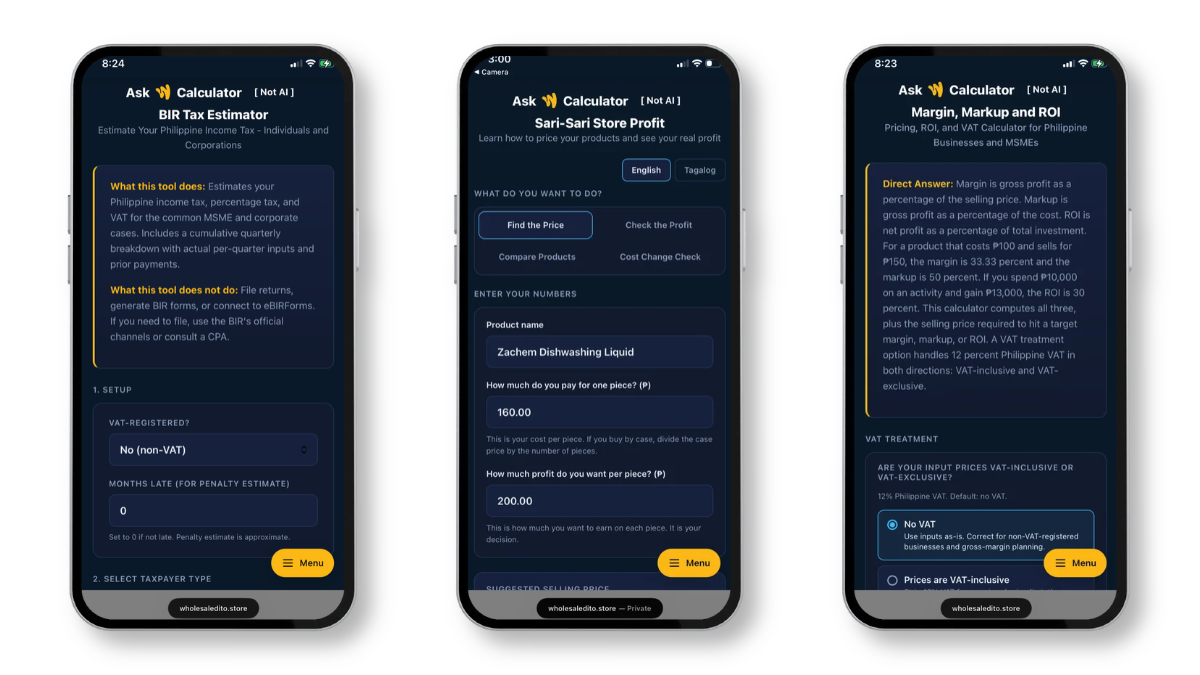
All of these belong on our own site, where we control how they are served, how they are indexed, and what happens to the data around them. None of them belongs in a feed built for passive scrolling.
The Sniffer as the Alternative
We built The Sniffer as the live lab for this approach. It is a business blog and a research log. We publish articles there and study how they perform in search engines, AI systems, and generative search interfaces. The structure, length, metadata, tone, schema, and thumbnail style of each article are deliberate.
This is the opposite of posting into a feed. A feed decides what to show and for how long. An indexed article is found by someone who is looking. We would rather be found by intent than shown by an algorithm we do not control.
What This Decision Does Not Solve
Choosing not to post much on social media does not solve everything.
- We still have a page. The Facebook page exists. We maintain it to secure the brand. We do not control what the platform does with it, how it ranks, or whether it is shown. A page we hold can still be indexed and can still appear in results.
- We lose reach we cannot measure. By not posting, we forgo whatever audience the platforms might have delivered. We cannot know what that would have been, because we are not running that experiment.
- Some buyers expect a social presence. A procurement officer who checks social media for activity may read our quiet page as a negative. We accept that risk, and this article is partly an answer to it.
- Data on Meta's systems is governed by Meta. Data that passes through Meta's systems, including messages sent through Messenger, is governed by Meta's terms, not ours. That is one reason we keep transactions and sensitive conversations on channels we control.
- Platforms change. What we observed may change. Our decision is based on what we have seen, and it is subject to revision if the platforms change in a way that serves us.
The Trade-Offs
Not posting much costs us something, and we are stating that plainly.
- Less reach. We reach fewer people through social channels than a company that posts daily.
- Less discovery. Some people find businesses through social media first. We are less likely to be found that way.
- A quieter brand presence. A quiet page can read as inactivity to someone who does not know why it is quiet.
- More work on our own site. If we are not posting, we must build the things that bring people in. That is slower and more demanding than posting.
These are real costs. We accept them because of what we gain: control over where our content lives, how it is found, and what happens to the traffic it earns. For a B2B supplier whose value is on its own site, that trade favors the site.
For another business, the trade could go the other way. A consumer brand selling impulse products may live or die by social reach. We are not that. Our buyers are procurement teams and business owners looking for a supplier, a price, or a tool. They search. They do not scroll past.
What to Ask Yourself Before Posting
If you run a business and you are deciding where your content belongs, these are the questions we asked ourselves.
- What does a post do for me that a page on my own site does not? If the answer is "reach," ask whether the reach is real and whether it converts.
- Can the platform take the click that was meant for me? If a public post can be indexed, it can appear in results. Ask whether that helps you or the platform.
- What is the lifespan of what I am publishing? A post dies in a day. An article or a tool can work for years. Decide which one the content deserves.
- Do I control what happens to the data? If the answer is no, keep transactions and sensitive conversations off the platform.
- Does a quiet page look worse than a busy ineffective one? In our observation, it does not. Effort that does not land can read worse than deliberate quiet.
- Am I posting because it works, or because it is expected? This is the question that started our decision.
Why This Matters for a B2B Supplier Specifically
A consumer brand and a B2B supplier do not have the same relationship with social media.
A consumer brand wants attention, and attention is what social platforms sell. A B2B supplier wants to be found by the right buyer at the moment that buyer is looking. That is a search problem, not a feed problem. A feed shows a person what the platform chooses. A search shows a person what they asked for.
Our buyers ask for things. They ask for a wholesale price, a calculator, a supplier in their region, a specification. Those questions are answered by pages that can be indexed and found, not by posts that decay in a feed. We would rather be the answer to a question than one more thing in a scroll.
Related Articles
This article is not part of our AI-behavior series. It is a standalone piece about platform behavior and distribution. The articles below are related in subject, and are part of that series.
- Agentic AI Commerce: Security Risks and Human-Verification Protocols (April 21, 2026). Human-verification protocols for AI-driven transactions.
- The Danger Google's AI Just Revealed (August 4, 2026). Gemini produced a fabricated response about this company.
- Ask W Direct [Not AI] (September 6, 2026). A deterministic alternative to AI search for product and pricing queries.
- Same Query, Three Answers: What Google AI Overview Gets Wrong About the Price Tag Law (September 21, 2026). Google AI Overview produced three different summaries of the same Philippine law.
- The Gemini AI Intrusion: What It Reveals About Attack Surface, and What to Ask Your Vendors (September 21, 2026). One of several publicly confirmed AI agent intrusions in 2026, and what architectural decisions reduce the attack surface.
Frequently Asked Questions
Does Wholesale Dito Store have a Facebook page?
Yes. The page is at facebook.com/WholesaleDitoStore/. We maintain it to secure the brand. We do not transact on it, and we do not post to it much.
Why do you not post much on social media?
Because, in our observation, it does not serve the goals the platform was built for us to serve. Posts that lead outward are shown to fewer people, public posts can be indexed and intercept search traffic, and social content has a short lifespan compared with an indexed article or tool.
Is this because social media hurts SEO?
No. This is not a claim that social media hurts search rankings. It is an observation about platform behavior and about where a click lands. In our observation, a public post can be indexed and can take a click that would have gone to the site. That is a distribution problem, not a ranking problem.
Do you post links on Facebook?
We post very little on Facebook, and the reasoning in this article is why. The observation is not limited to posts with links. A post that draws attention outward, with or without a link, behaves in the way we describe.
What is the 50 percent engagement drop I have heard about?
We do not cite a figure. What we report is what we observed: in our experience, posts that led outward reached fewer people than posts that did not, and reach fell over time. Anyone quoting a specific percentage should be able to show where it came from. We cannot, so we do not.
Why keep the Facebook page at all?
To control our own name. A page we hold is better than a page someone else holds in our name. Holding it is not the same as feeding it.
Do you control the data on Facebook?
No. Data that passes through Meta's systems, including messages sent through Messenger, is governed by Meta's terms, not ours. That is one reason we keep transactions and sensitive conversations on channels we control.
Where do transactions happen?
On our own website. Wholesale Dito Store does not employ field sales agents and does not conduct transactions or accept orders through social media platforms. All transactions are conducted directly through our official website.
What should a buyer conclude from a quiet social page?
Not that the company is inactive. It may be a deliberate choice. Check the company's own site, its catalogue, its tools, and its documentation. That is where a B2B supplier's work is.
Is this the right decision for every business?
No. A consumer brand selling impulse products may need social reach. A B2B supplier whose buyers search for a price or a tool may not. The decision depends on who your buyer is and how they find you.
Will you ever post more on social media?
Possibly. This decision is based on what we have observed. If the platforms change in a way that serves our buyers, the decision can change.
What do you do instead of posting?
We publish articles and build tools on our own site. The Sniffer is our research log. The calculators, the price manifests, and the documentation live on our own domain, where we control how they are served and found. The calculators include the Margin, Markup, and ROI Calculator, the BIR Tax Estimator, and the Sari-Sari Store Profit Calculator.
Summary
A B2B supplier does not post much on social media because, in our observation, it does not serve the goals the platform was built for us to serve. Social platforms keep users inside the platform, and posts that draw attention outward are shown to fewer people. A public post can be indexed, and in our observation can take a click that would have gone to the site. Social content decays quickly, while an indexed article or tool can keep working for years.
We keep a Facebook page to secure the brand, but we do not transact on it and we do not feed it. Our value is on our own site: the catalogue, the pricing, the RFQ process, the settlement system, the articles, and the tools. That is where our buyers find us, because they are searching, not scrolling.
This article contains no internal metrics, and that is deliberate. Where we cite figures, they are external and named. We did not run a controlled study, and we will not cite figures we cannot show.
Outro
Published by The Sniffer, the strategic insights blog of Wholesale Dito Store. This article is provided as a public reference for business owners, procurement teams, and technology companies in the Philippines. This article reflects years of direct observation by our technical co-founder, not a controlled study. Wholesale Dito Store operates on a zero-dependency architecture. The company is operated by Clickerwayne Zelle Solutions Inc, Forest Drive St., corner Country Drive, Country Homes, Biñan, Laguna 4024, Philippines. Questions can be sent to customercare@wholesaledito.store.